


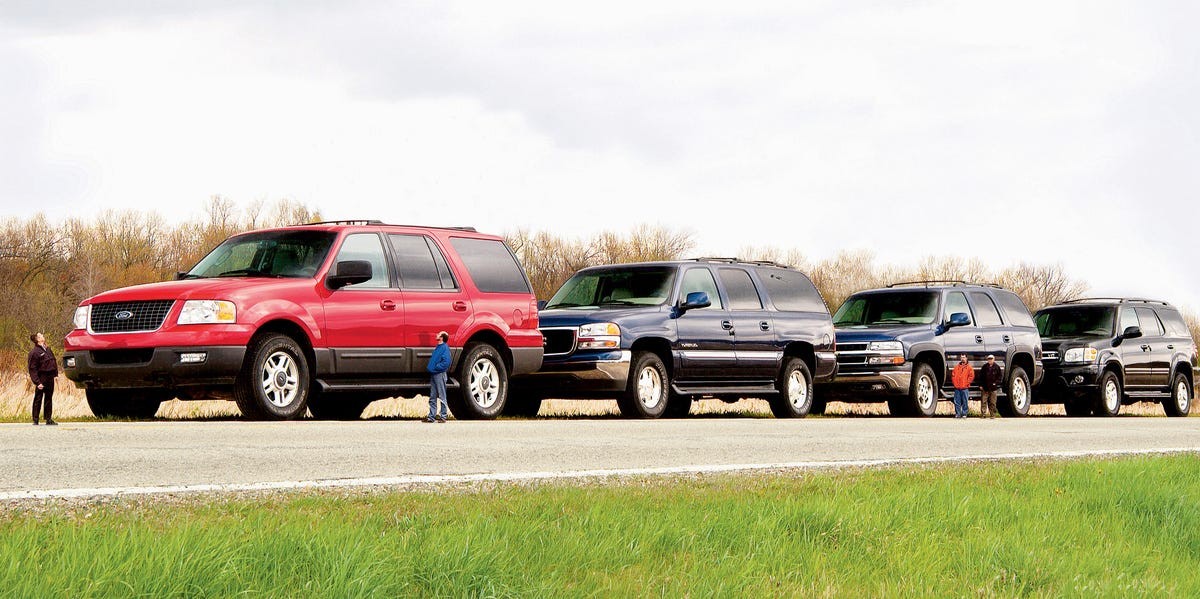
The full-size SUV market is a strange one. Americans buy nearly 850,000 of these behemoths each year—about 10% of all light trucks sold—despite the fact that most owners don’t actually need them for hauling travel trailers or conquering wilderness. They buy them because these vehicles make others feel small. This isn’t about utility; it’s about dominance.
Chevrolet pioneered this segment in 1935 with the Suburban, and it remains the king, controlling over 60% of the market with its Suburban and related models (Yukon, Denali, Escalade, Hummer H2). The current generation, redesigned in 2000, has already proven itself in tests, but the competition is catching up.
This comparison revisits the field, focusing on towing, off-roading, and passenger comfort—the traits owners claim they need. The goal: determine which of these trucks justifies its price tag… or at least provides the best excuse for owning one.
Ford Expedition XLT: The Practical Choice
The Ford Expedition stands out as the most sensible option. Its redesigned interior is a revelation, offering real space for up to eight adults with fold-flat third-row seats that don’t require Herculean effort to stow. This alone makes it worth considering for large families.
Safety is also a strong suit, with available stability control and side-curtain airbags. The independent rear suspension improves handling, but the ride is stiff and jittery, especially over rough roads. The 5.4-liter V-8 is powerful enough for towing up to 8650 pounds, but it lacks refinement compared to the competition.
The Expedition also suffers from a recalcitrant four-wheel-drive system that can take minutes to engage low range. Despite these flaws, its value proposition is unmatched, starting at $31,495 and costing $42,220 as tested.
Verdict: A solid, practical choice that sacrifices refinement for space and affordability.
Toyota Sequoia Limited V-8 4WD: Quiet Competence
Toyota entered the full-size SUV arena with the Sequoia in 2001, essentially copying the Chevy Tahoe formula. The result is a competent but unremarkable vehicle. The Sequoia’s interior is quiet and well-built, offering comfortable seating and ample space.
However, Toyota’s overreliance on electronic aids ruins the off-road experience. The traction control system is overly aggressive, hindering progress in muddy conditions. The engine, borrowed from Lexus, lacks the grunt needed for serious towing (max 6200 pounds).
The Sequoia excels in refinement and reliability, but it lacks the raw capability of its rivals.
Verdict: A quiet and competent performer that doesn’t excel in any one area.
GMC Yukon XL SLT: The Long-Hauler
The GMC Yukon XL is the veteran of this group, drawing on decades of experience. It’s the largest vehicle here, offering maximum passenger and cargo space. With a 5.3-liter V-8, it can tow up to 8600 pounds (or 12,000 pounds in three-quarter-ton trim).
The Yukon XL’s suspension is well-tuned, minimizing body roll and maximizing comfort. However, its long wheelbase makes it vulnerable to underbody damage on rough terrain. The rear trailer hitch wiring harness is also poorly protected, prone to shearing off on off-road adventures.
Despite these minor flaws, the Yukon XL remains a capable and versatile vehicle.
Verdict: A well-rounded performer that balances comfort, capability, and space.
Ultimately, the choice comes down to priorities. The Expedition is the most practical, the Sequoia the most refined, and the Yukon XL the most capable. None of these trucks are perfect, but they all serve a purpose: making their drivers feel dominant.


