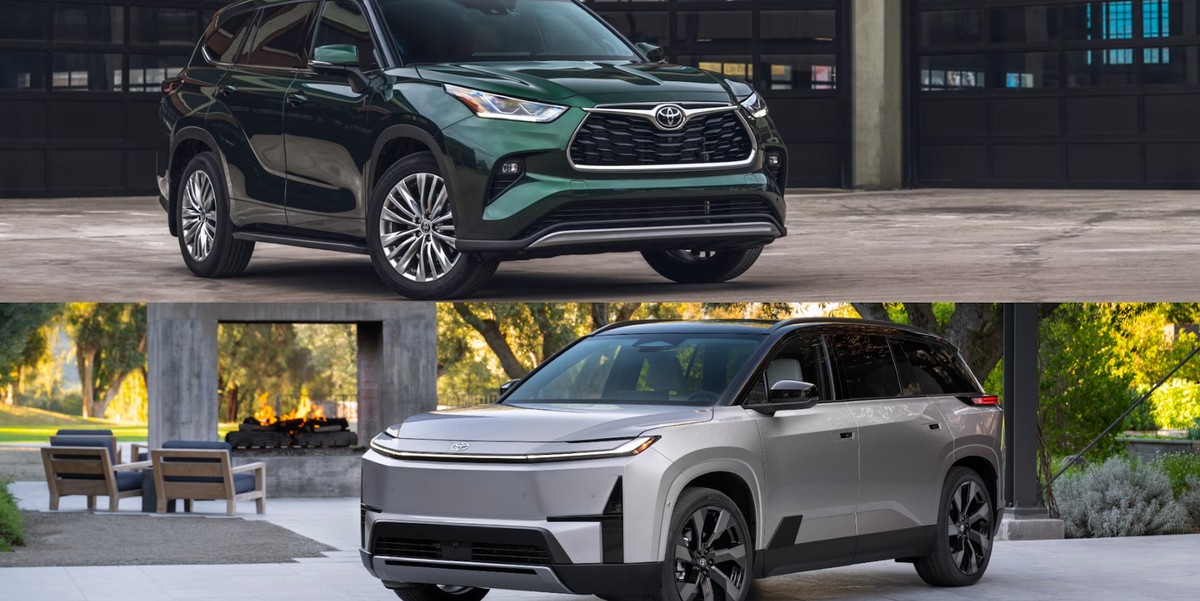
The 2027 Toyota Highlander represents a radical departure for the once-dominant mid-size SUV. Faced with declining sales – partially due to competition from its own larger Grand Highlander sibling – Toyota has ditched the internal combustion engine entirely in favor of an all-electric powertrain. This isn’t just an upgrade; it’s a complete reimagining.
Powertrain Shift: From Gas to Electric
The previous Highlander offered a choice of gasoline and hybrid engines. The standard gas model packed a turbocharged 2.4-liter four-cylinder with 265 horsepower, paired with an eight-speed automatic transmission. The hybrid variant delivered 243 combined horsepower from its 2.5-liter engine and electric motors, utilizing a continuously variable transmission (CVT).
The 2027 Highlander EV takes a different approach. The base model is front-wheel drive, producing 221 horsepower and 198 pound-feet of torque, with an estimated range of 270 miles from its 77-kWh battery. Stepping up to all-wheel drive adds a rear electric motor, boosting output to 338 horsepower and 323 pound-feet of torque, along with a longer range of 320 miles thanks to a larger 96-kWh battery. This marks Toyota’s commitment to electrification, aligning the Highlander with its broader EV strategy.
Dimensions: Bigger, Lower, and Longer
The electric Highlander’s dimensions have been significantly altered. While it falls between the standard Highlander and the Grand Highlander in overall size, it boasts notable changes:
- Roofline: Lowered by nearly an inch to 67.3 inches.
- Width: Increased by 2.3 inches to 78.3 inches.
- Wheelbase: Extended by 8.1 inches to 120.1 inches.
- Overall Length: Grown by 3.9 inches to 198.8 inches.
The stretched wheelbase suggests improved passenger space, though Toyota has not yet released detailed interior dimensions. These changes are designed to give the EV a more planted stance and accommodate the larger battery pack.
Interior: Modernized, But With Trade-Offs
The Highlander EV’s interior receives a substantial upgrade with a 12.3-inch digital gauge cluster and a larger 14.0-inch touchscreen. Modern conveniences like wireless charging and USB-C ports are also included. However, despite the longer wheelbase, cargo space has actually decreased. The 2027 model offers only 16 cubic feet of space with the third row up (down from 23 in the outgoing model), and 46 cubic feet with the third row folded (compared to 57 previously). The absence of a frunk—a front trunk commonly found in EVs—further limits storage capacity. This is a clear compromise, likely due to packaging constraints related to the electric drivetrain.
The Highlander EV’s redesign reflects Toyota’s adaptation to changing market demands. The move to an all-electric powertrain is a bold step, but the reduced cargo space may be a point of concern for families who relied on the previous model’s generous storage capacity.