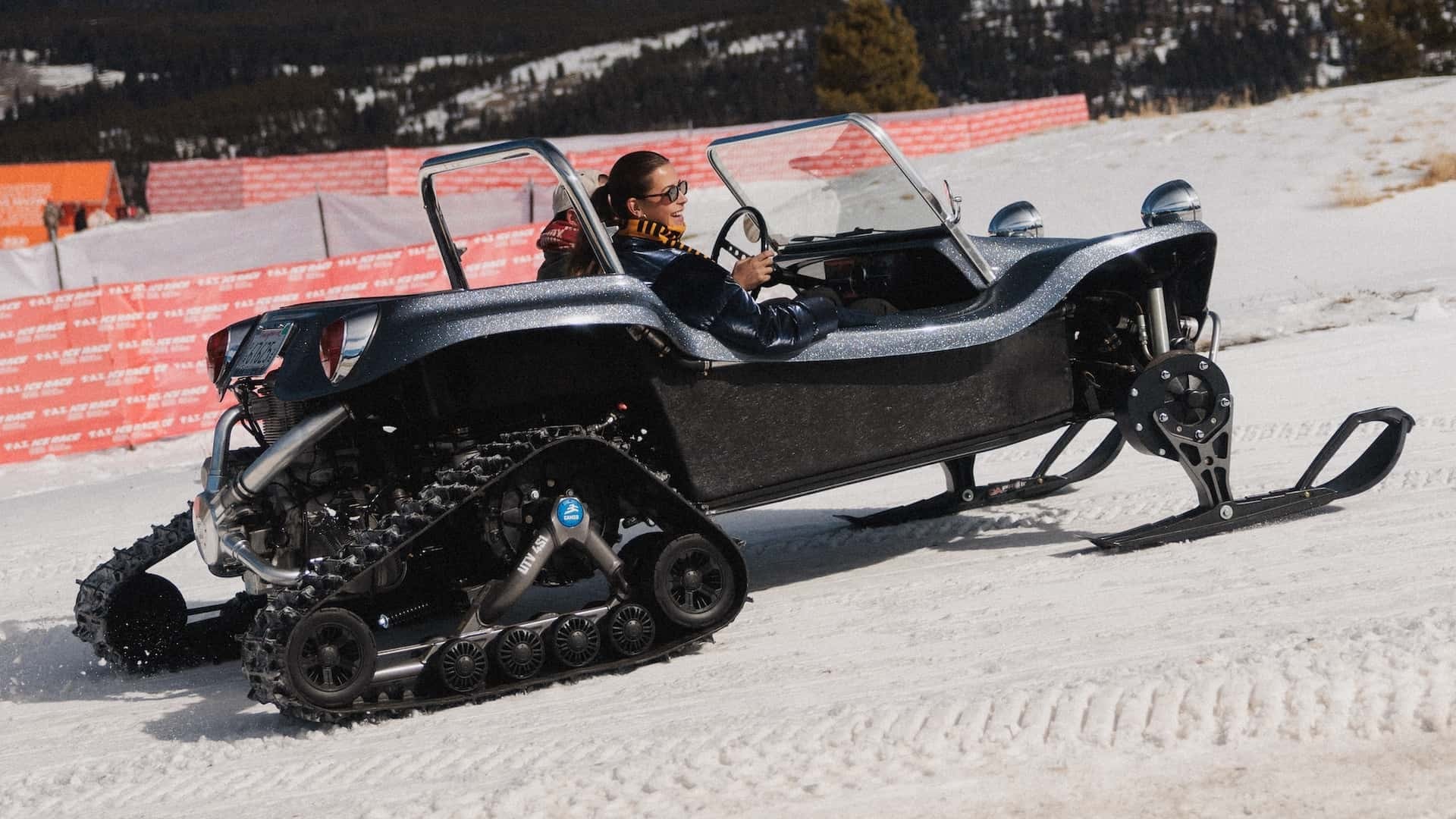
At the FAT Ice Race Big Sky, the paddock looks less like a traditional racing event and more like a high-octane fever dream. In one corner, you might find a priceless Ferrari 250 GTO; in another, a rugged Ford Raptor Trophy Truck or a rally-prepped Toyota Corolla. Amidst this collection of automotive heavyweights, the Meyers Manx buggies stand out—not because they are the fastest, but because they represent a singular, driving philosophy: pure, unadulterated fun.
The Engineering Marvel: A Radial Heart
The centerpiece of this experience is a unique Manx buggy powered by the “Radial Motion,” a three-cylinder engine crafted by Australia’s Bespoke Motors.
Unlike modern, homogenized engines, this is a radial configuration —a design reminiscent of the legendary powerplants found in vintage warbirds. The cylinders fan outward from a central crankcase, creating a mechanical aesthetic that is as striking as it is unconventional.
While the architecture is exotic, the engineering is grounded in proven reliability:
– The Pedigree: The internal components—pistons, connecting rods, and valves—are derived from the legendary GM LS series, ensuring a level of mechanical pragmatism beneath the “weird” exterior.
– The Specs: It is a lively 2.0-liter unit producing 120 horsepower and 100 lb-ft of torque. While modest by supercar standards, in a lightweight fiberglass buggy, this power is perfectly balanced for agility.
– The Details: The engine features a dry-sump lubrication system and an aviation-style manual scavenging pump, adding to its mechanical character.
The Spirit of FAT International
To understand why such an eclectic mix of vehicles gathers in Montana, one must understand FAT International. Originally a European logistics company known for sponsoring Le Mans-winning teams in the 90s, FAT has undergone a modern rebirth.
Today, the brand has transitioned into a lifestyle and motorsport powerhouse. Through events like the FAT Ice Race, they have mastered a difficult feat: bridging the gap between hardcore motorsport enthusiasts and casual fans who value design, culture, and unique experiences. By trucking in massive amounts of snow to create an ice course in a dry Montana winter, FAT demonstrates a commitment to creating “spectacle” that goes beyond simple lap times.
Mastery Through Chaos: Driving on Ice
Driving a rear-engined buggy on a frozen track is an exercise in controlled instability. Unlike driving on asphalt, where grip is the goal, driving on ice is a constant negotiation with physics.
The key to mastering a Manx on a loose surface is simple: expect to spin, then work backward from that reality.
The experience is visceral. Between the distinct, throaty note of the three-cylinder radial engine and the constant need to counter-steer through hairpin turns, the driving becomes an intuitive dance. On a loose surface, the vehicle is highly communicative; you feel every weight transfer and every slide, turning a technical driving task into a moment of genuine euphoria.
Why the Manx Matters
In an era where performance vehicles are increasingly digital, heavy, and expensive, the Meyers Manx offers a refreshing counter-narrative. It is a “small-batch” vehicle that prioritizes sensory engagement over raw statistics.
With a price tag in the low six figures, it occupies a unique niche. It is a collector’s item with a loyal following, yet it remains a tool for play. Whether it is navigating the dunes of Baja or the frozen tracks of Big Sky, the Manx proves that the most memorable vehicles aren’t always the ones that win the race—they are the ones that stay in your mind long after the engine has cooled.
Conclusion: The radial-engined Manx is a masterclass in purposeful eccentricity, proving that when you combine unconventional engineering with a loose surface, the result is unparalleled driving joy.