Change was the only constant in the 1950s hot rod scene. A finished custom wasn’t a final product. It was a canvas. If the car changed hands, the new owner usually felt compelled to strip it back and put his own stamp on the metal. Keeping pace with quickly shifting automotive fashion meant constant modification.
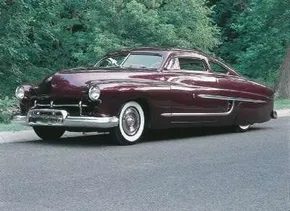
The Buddy Alcorn Mercury is a perfect example of this fluid design process. Built on a 1950 Mercury, the car was first completed in 1952 by brothers Gil and Al Ayala. They didn’t just polish chrome. They fundamentally reworked the silhouette.
The Ayala Brothers’ Initial Chop
The Ayalas started with a heavy hand. They chopped the roof four inches in the front and a massive 7-1/2 inches in the rear. The result was a tapered slope that mimicked fastback proportions years before the style hit the mainstream.
They rounded the hood and deck corners to soften the boxy lines. Door handles and excess chrome were removed entirely. Clean lines matter more than stock hardware.
The signature Mercury doorline hump was reworked into a smooth “full fadeaway” body line. It’s a subtle but critical detail that defines the car’s profile. Rear quarter panels and taillights from a 1952 Oldsmobile were grafted on. The car was painted a deep maroon.
These self-taught designers relied on innate design intuition, not professional degrees.
The Barris Kustom Transformation
Buddy Alcorn bought the car later. He brought it to Barris Kustom Autos in 1955. Sam Barris and his crew took over.
They updated the trim. They installed new taillights. The paint job changed to a deep eggplant color. This wasn’t just a refresh. It was a complete evolution of the vehicle’s identity.
The 1950s’ best customizers were highly skilled at blending bits and pieces from various cars into a cohesive new design. There was no set template. No professional design degrees involved. These self-taught designers simply relied on their own innate design intuition.
Why This Matters for Restoration
Today, restoring a car like the Buddy Alcorn Mercury requires understanding its layered history. You aren’t just restoring a 1950 Mercury. You’re restoring a 1952 custom and a 1955 Barris Kustom.
Which parts belong to which era? How much of the Olds hardware is original to the Ayala build versus the Barris update?
The car proves that these builds were living projects. They adapted. They survived. They remained relevant through sheer audacity.
There is no museum plaque that captures the exact moment the paint dried on that eggplant job. There is only the car itself. And the stories it carries.

The Art of the Patchwork Pre-’56 Custom
The Alcorn Mercury didn’t just look good. It looked like it belonged. That’s the trick with high-end pre-1956 customs. You aren’t buying a car. You’re buying a collage of parts that somehow, impossibly, work together.
Take the front end. The headlight bezels came from 1952 through 1954 Ford or Mercury models. Customizers loved them for that clean, “frenched” look where the lights sit flush and deep. But the grille tells a different story. It’s a narrowed 1952 Oldsmobile bar. Someone added two extra teeth to it. Just two. Enough to change the character.
The bumpers are a mix of eras. Front unit is a 1951 Mercury piece. The rear is a 1952 Ford with exhaust outlets molded right into the body. Both are capped with guards taken from a 1955 Pontiac. It’s not random. It’s curated.
Side Profile and Trim Details
Side trim follows the same logic. The upper spear is a 1955 Chevy line. The lower border? An inverted 1953 Dodge piece. Right there, a hand-formed scoop sits on the fender. The scoop is edged with teeth from a 1954 Mercury. It frames the cutout without looking like an afterthought.
“To the credit of the Ayalas and Barrises, none of these additions and alterations looks tacked-on.”
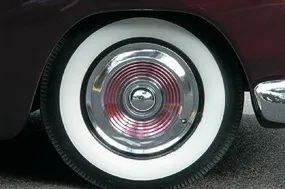
The rear lights are 1955 Plymouth units. Round, distinct, period-correct for their source but alien in context. Hubcaps are 1956 Mercury originals. Modified with bullet centers and painted to match the body. Every bolt, every curve, every shadow has been considered.
Why the Style Died
This level of detail required skilled labor. Hours of filing, fitting, and welding. It was slow. It was expensive. It was dying.
As the 1950s moved toward 1956, Detroit started pushing lower, flashier cars. Consumers didn’t want to wait months for a custom. They wanted instant gratification. For roughly the same cost as building this Alcorn Mercury, you could walk into a showroom in 1957.
Buy a new model. Lower it. Swap a few trim pieces. Hit it with a wild paint job. Result? A car with similar visual impact. Fraction of the time. Fraction of the effort.
The traditional custom became obsolete almost overnight. The Alcorn Merc was a relic of a vanishing craft.
The Mercury’s Second Life
Buddy didn’t keep the Merc forever. He traded it to Dick “Peep” Jackson, a Barris employee. Jackson’s trade was a mildly customized 1957 Ford.
Jackson took the old Mercury and gave it a fresh coat. Pinstriped two-tone paint. Clean. Simple. He didn’t try to recreate the complex patchwork. He just made it pretty. Then he moved on. The Merc was traded again. This time for a 1957 Thunderbird.
The Alcorn Mercury vanished into the stream of hot rod commerce. Just another piece in the puzzle. Another story told through chrome and
The Long Road Back to Form
It was one of the sharpest customs to roll off a Barris Kustoms sheet metal shop in the golden age of hot rodding. Style? Flawless. Execution? Top-tier. But trends shift. Fast. By the time the Alcorn Merc’s unique flair went out of fashion, the writing was on the wall. It didn’t vanish into a private garage. It landed on a used-car dealer’s lot. That’s where the real decay began.
Years of sitting outside, exposed to rain, sun, and neglect, took their toll. The paint faded. The metal rusted. The chrome clouded over. The car changed hands a few times, each owner likely seeing it as a project too far gone. It sat there. Waiting. Rotting.
Then, in 1998, Kurt McCormick saw what others missed. A noted collector and restorer of Barris Kustoms pieces, Kurt didn’t see a wreck. He saw history. He acquired the remains. What followed was a grueling, multi-year restoration process. Not a quick paint-and-go job. This was surgery on a classic.
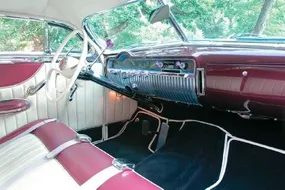
By 2002, the work was done. Mechanical updates were tucked away where they belong. Modern creature comforts were added sparingly, if at all. The goal wasn’t to make it new. It was to make it original. The Alcorn Merc emerged from the shop looking exactly as it did under the Barris Kustoms sign decades prior. Every curve. Every line. Every detail. Restored. Not rebuilt. Restored.
Preserving the Barris Legacy
The Alcorn Merc story isn’t just about one car. It’s about why these cars matter. How do you bring back a custom from the brink without losing its soul? The answer lies in obsessive attention to period-correct details. It’s not just about chrome or paint. It’s about understanding the original intent. The way the metal was shaped. The way it moved. The way it looked parked on a boulevard in 1950s Los Angeles.
Restoring a Barris Kustoms piece isn’t for the faint of heart. It requires sourcing rare parts. Matching factory finishes. Replicating interior materials that haven’t been made in decades. Kurt McCormick didn’t cut corners. He didn’t rush. He respected the history. The result? A car that doesn’t just look right. It feels right.
This is part of a larger conversation about preserving automotive history. How many custom cars are lost to time? How many sit in barns, fading, forgotten? The Alcorn Merc survived. Because someone cared enough to fight for it.
Why This Matters to Enthusiasts
For those of us who love cars, the Alcorn Merc is a case study. It’s proof that even the most deteriorated projects can be saved. If you’re into hot rods, custom cars, or Barris Kustoms, this story should resonate. It’s not just about the metal. It’s about the story. The people. The passion.
How do you start a restoration? Where do you find parts? Which details are non-negotiable? The Alcorn Merc’s journey offers clues. It shows that patience pays off. That research matters. That respecting the original design is key.
The car isn’t