Most modern passenger cars have evolved. They use a rack and pinion system. You know the type. This is easy. it works. It offers the quick response expected from a sports sedan.
But look under the hood of a large truck or large SUV. The Recirculating Ball Steering system may still be installed. This is an old model. It feels different. It can withstand huge steering forces that are sometimes difficult with rack and pinion.
The linkage is distinct. Spinning these gigantic wheels requires special mechanical tricks without requiring superhuman strength from the driver.
Worm and nut mechanism
The heart of the system is the worm gear. Don’t be scared when you hear the name. It’s simple physics. Imagine two main components interacting inside a steering box.
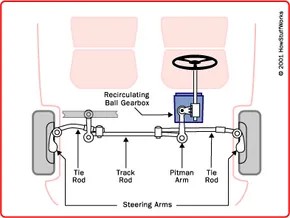
The first part is a metal block. There is a screw hole in the middle. Think of it like a nut. However, teeth are engraved on the outer circumference of the nut. These teeth engage the sector gear. This sector gear is connected to the pitman arm. The pitman arm is a critical link that transfers motion from the steering box to the rest of the suspension and tie rods.
The second part is input. This is a threaded rod. Attaches directly to the steering column. Turn the wheel and the bar rotates.
Typical bolts are tightened by twisting the bolt into a set nut. It goes even deeper. It would stall.
This is not a standard bolt. The threaded rod is held in place axially. You cannot go forward or backward. It can only spin.
Convert rotation to motion
So when you spin the rod, something has to give. Since the rod cannot move vertically, the metal piece (nut) is forced to move.
The rotation of the rod pushes the block up and down inside the housing.
This is where the magic happens. The block does not just slide. It contains ball bearings. The ball rotates between the threads of the rod and the threads of the block. They circulate through the channels, reducing friction to almost zero.
When the block moves in a straight line, its external teeth push against the sector gear.
The sector gear pivots.
This pivot moves the pitman arm.
The pitman arm pulls or pushes the drag link.
The drag link moves the tie rods.
The tie rods angle the wheels.
Why use it?
Why continue to maintain this complex and large system?
It handles torque better. Rack-and-pinion systems can suffer from binding under extreme loads. They are stiff. They are not forgiving.
The recirculating-ball design is more forgiving. It absorbs road shocks better. If you hit a pothole on the highway with a two-ton truck, the system probably won’t take the steering wheel out of your hands. It is smoother. It is robust.
It also facilitates integration with power steering systems. The linear force required to move the nut is small. It can easily be assisted by a hydraulic pump or an electric motor.
The Trade-offs
It’s not perfect. There are many more moving parts in the system. More friction points. More wear. It requires regular lubrication. rack-and-p
The important thing here is not how the bolt attaches to the block, but what fills the gap. Traditional threads are gone. Instead, the ball bearing rings circulate inside the gear as it rotates.
This isn’t just flashy engineering. The ball enables heavy lifting by reducing friction and wear. But what is their real job? Kill the slop.
Without this, the steering feels vague. When you change direction, the teeth lose contact. The wheels feel loose. Not connected. The balls bridge that gap. They keep everything solid. Immediate feedback.
The power steering in this configuration mirrors the rack and pinion system. Pumping high pressure fluid to the other side of the module may help. A simple mechanism. effective results.
But it’s not all about the gear.
Beyond the Gear
The complete power steering system is based on more than just a recirculating ball unit. Pumps, pipes, tanks and control valves must work together. Each component handles a specific load.
- Pump: Creates the pressure needed to spin the wheels effortlessly.
- Pipelines: Transports fluids under pressure. If it was a normal pipe, it would break, so it’s reinforced.
- Container: Contains liquid. It should be cold and without bubbles.
- Control valve: Controls flow based on input. It is the brain of the hydraulic circuit.
Neglecting any of these parts will cause the entire system to fail. Worse, it feels inconsistent. A vague steering isn’t just annoying. This is dangerous. Precision matters.
Mechanical backlash is solved by recirculating ball gear. The rest of the system handles the force. Together, you can turn a two-ton machine with one hand.
Where does the liquid go next? The pressure difference pushes the piston. Now comes the real work. The rest is just a pipe.