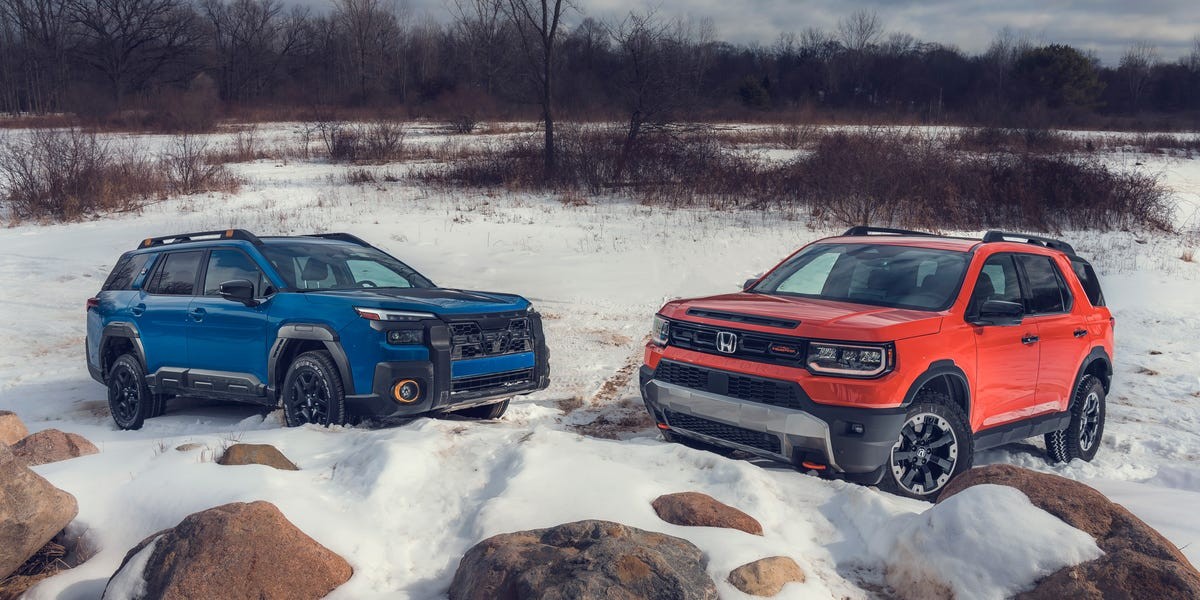
Automakers recognize that many buyers want the appearance of off-road capability without needing extreme performance, and the mid-size SUV segment is full of models catering to this desire. The Honda Passport TrailSport and Subaru Outback Wilderness represent established players in this trend, promising a blend of on-road comfort and rough-terrain prowess. Both have been updated for 2026, with the Passport adopting a bolder design and the Outback shifting toward a more upright SUV silhouette. This comparison test evaluates which vehicle strikes the better balance between capability and daily usability.
Exterior Styling: A Tale of Two Approaches
Subaru’s redesign of the Outback has drawn criticism from loyalists who miss the wagon-like aesthetic of previous generations. The 2026 model’s SUV shape still retains Subaru’s utilitarian vibe but feels like a forced adaptation rather than a natural evolution. The Wilderness trim features a unique hexagonal grille and black cladding, accented with gold details – a visual treatment that doesn’t quite coalesce.
The Honda Passport TrailSport, conversely, leans into its rugged look more organically. Its blocky sheetmetal already projects a tough image, and the TrailSport package adds underbody skid plates, amber running lights, and exposed tow hooks for a more purposeful appearance. The knobby General Grabber A/T Sport tires further reinforce this impression, contrasting sharply with the Subaru’s less aggressive Bridgestone Dueler all-terrain tires.
Interior Accommodations: Practicality vs. Style
Both SUVs offer similar amenities in their premium trims, including heated seats, wireless charging, and premium audio. The Subaru Wilderness’s optional $4090 Package 23 adds features like ventilated seats and a sunroof, but the interior design feels disjointed. The black leather with copper stitching lacks visual appeal, and the materials don’t match the exterior’s rugged pretensions.
The Honda Passport excels in material quality, with softer surfaces and less scratchy plastic. Its two-tone black-and-brown leather interior is more aesthetically pleasing, though not luxurious. More importantly, the Passport offers significantly more interior space, feeling closer to a full-size SUV in roominess. The rear seats have ample legroom, and the cargo area is larger, accommodating more luggage than the Outback.
The infotainment systems in both vehicles are responsive, but the Passport’s 12.3-inch display integrates more seamlessly into the dashboard. Subaru’s trapezoid-meets-rectangle design feels awkward in comparison.
Powertrain and Performance: Power vs. Efficiency
The Honda Passport TrailSport is powered by a naturally aspirated 3.5-liter V-6 engine producing 285 horsepower, paired with a 10-speed automatic transmission. The Subaru Outback Wilderness uses a turbocharged 2.4-liter flat-four engine with 260 horsepower and a CVT.
The Outback is quicker off the line due to its lighter weight (4016 lbs vs. 4702 lbs for the Passport) and turbocharger, reaching 60 mph in 6.0 seconds compared to the Passport’s 7.1 seconds. However, the Honda’s V-6 delivers a more engaging driving experience with smoother power delivery, despite its slower acceleration. The Outback’s CVT feels numb in comparison, though improvements have been made over previous Subaru models.
Fuel economy favors the Outback, achieving 19 mpg in testing versus the Passport’s 17 mpg, though both fall short of their EPA estimates.
Driving Experience: Comfort and Capability
On the road, the Outback feels more carlike due to its narrower body and lower seating position, but its steering lacks precision. The Passport feels more planted with its wider stance and more direct steering. The Outback’s adaptive dampers improve ride quality over previous models, but the Passport’s softer suspension better absorbs minor road imperfections.
Braking performance is comparable, with both stopping from 70 mph in around 175 feet. The Passport demonstrated superior lateral grip, circling the skidpad at 0.84 g.
Off-Road Capabilities: Where the Passport Shines
The real test came at the Mounds ORV Park, where the Passport’s superior ground clearance and torque-vectoring all-wheel-drive system proved decisive. The Subaru Wilderness struggled with steep inclines, its stability control system intervening frequently and hindering progress. The Passport tackled obstacles confidently, its more aggressive tires providing better traction.
The Outback’s forward-collision nannies also interfered, cutting power during uphill climbs until disabled manually – a frustrating oversight for an off-road-themed vehicle. The Passport, by contrast, performed without such limitations.
Conclusion:
The Honda Passport TrailSport emerges as the more practical and capable choice. It offers a spacious interior, a refined driving experience, and genuine off-road prowess without sacrificing on-road comfort. While the Subaru Outback Wilderness improves on previous iterations, it falls short in delivering a cohesive package that lives up to its rugged aspirations. The Passport proves that sometimes, bigger is better, especially when tackling tough terrain.