The intersection of aviation and high-performance motoring is no coincidence. Both disciplines demand a visceral connection between operator and machine, requiring the management of analog forces and a comfort with calculated risk. This shared spirit explains why many pilots find themselves drawn to driving lightweight sports cars, and why many Caterham owners eventually take up flying. The connection is so strong that the official Seven club magazine is aptly titled Lowflying.
Given this synergy, there is perhaps no more fitting stage for a Caterham than Wales’ Mach Loop. Located near the town of Machynlleth, this series of valleys has become the premier destination in the UK for military aircraft practicing low-altitude maneuvers. It is a place where F-22 Raptors and other jet fighters scream through the narrow gaps between hills, just feet above the ground.
The Vehicle: A Return to the CSR
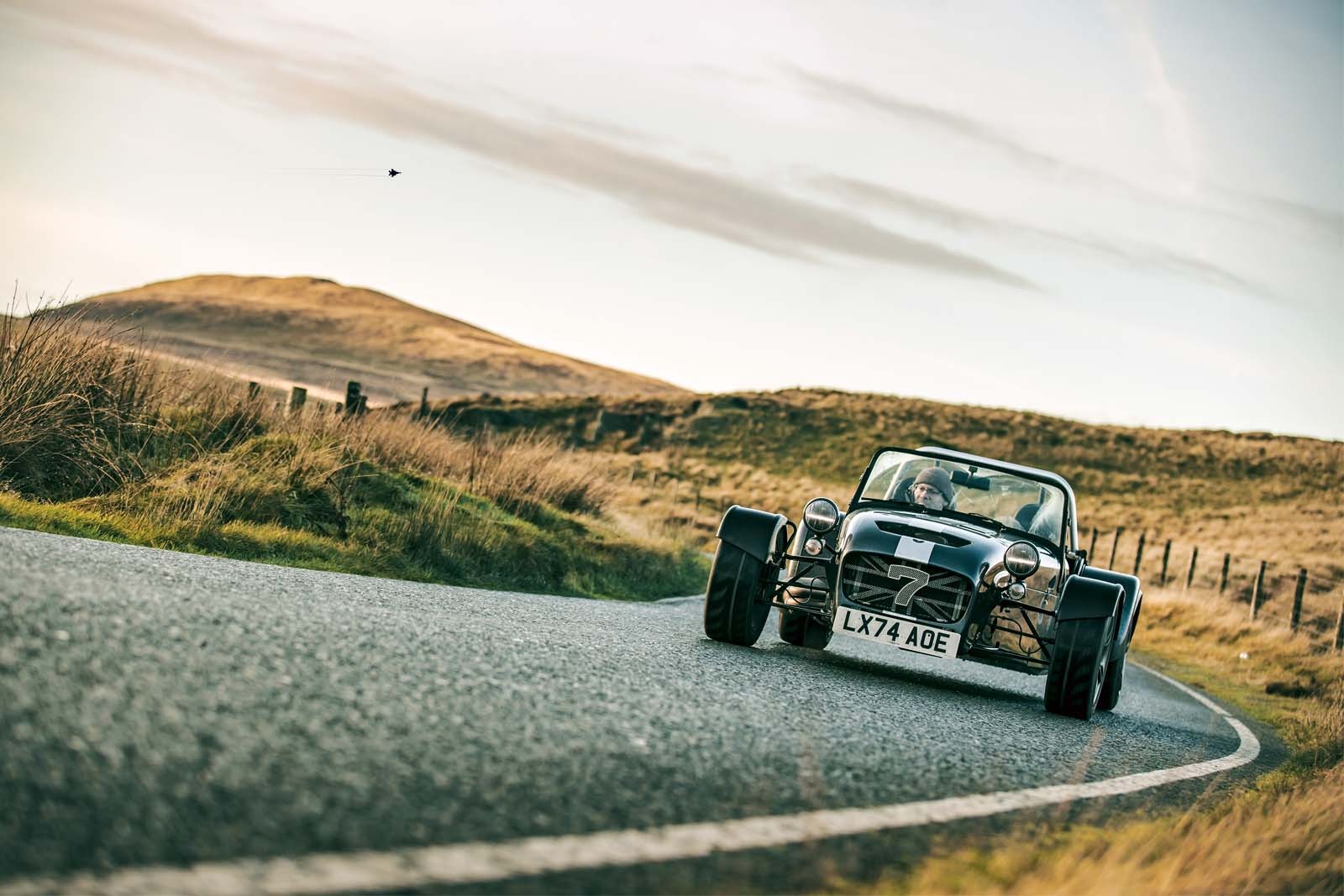
For this expedition, the vehicle of choice was not just any Seven, but a Caterham CSR. First introduced twenty years ago, the CSR represented a significant evolution for the Kent-based manufacturer. It was designed to be a “new dawn” for the brand—broader, smoother, and more capable than its predecessors, while retaining the essential lightweight character that defines the Seven.
The CSR addressed a specific need: the desire for speed without the punishing ride quality of earlier, harsher models. It offered a marginally more comfortable interior and a chassis tuned for relaxed high-speed cruising, making it ideal for navigating the winding valley roads leading to the airshow sites.
Design and Dimensions
For enthusiasts of the brand, the CSR possesses a distinct visual identity. While based on the standard Seven platform, it is immediately recognizable to those who know what to look for.
- Standard Seven: 3,180mm long × 1,470mm wide.
- CSR (Large Chassis): 3,360mm long × 1,700mm wide.
While the “large chassis” option can be applied to a standard Seven to achieve similar dimensions, the CSR features unique aerodynamic and mechanical details that set it apart. These include more streamlined front wings and additional airflow vents designed to manage air pressure.
Perhaps the most striking engineering feature is the suspension layout. Unlike traditional setups, the CSR utilizes inboard front springs driven by pushrods. This design allows for aerodynamically profiled front wishbones—made of carbon fiber on this test car—which sit cleanly alongside the front wings.
The Pursuit of Performance
Attempting to refine the aerodynamics of a Caterham Seven is a nuanced endeavor. Because the car is already so light and fast, adding subtle aero aids is akin to fitting secondary glazing to a single window in a vast palace; the impact is marginal, but it contributes to the overall efficiency.
However, the goal of the CSR was never just raw downforce, but rather balance. By smoothing out the ride and improving high-speed stability, Caterham created a car that is faster yet more relaxed than its ancestors. It is a vehicle designed not just for the track, but for the open road—making it the perfect companion for a journey into the danger zone of the Mach Loop.
The CSR proves that performance does not require punishment. By refining the Seven’s inherent character, Caterham created a car that is both faster and more civilized, bridging the gap between raw mechanical interaction and everyday usability.