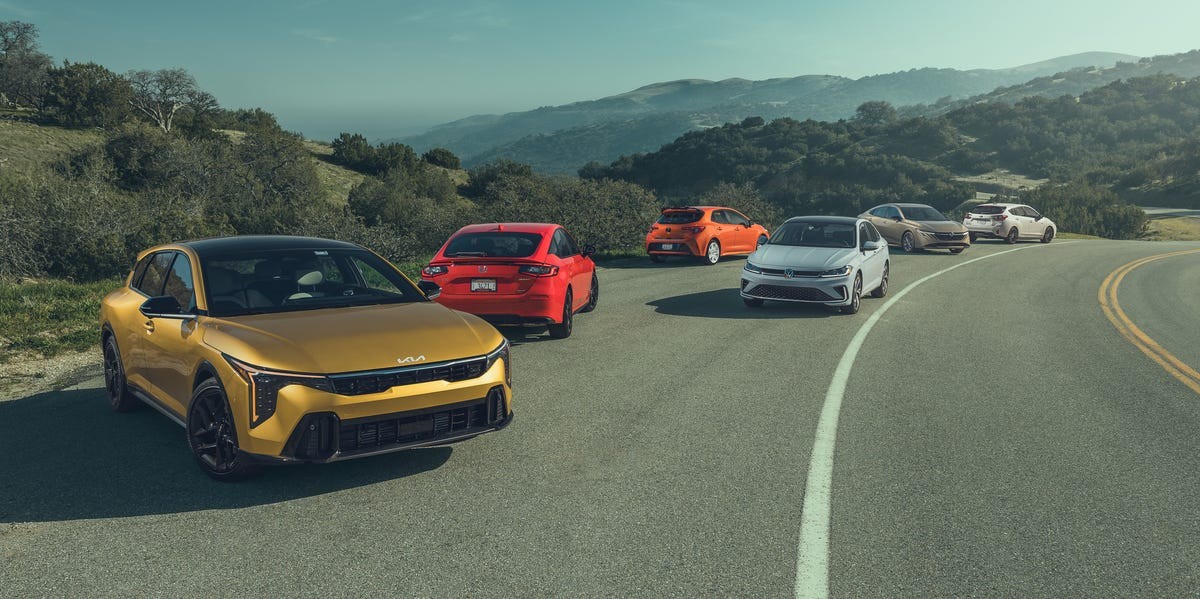
The landscape changed. Back in 2005? You had choices. Ford. Chevy. Dodge. Maybe even Saturn if you were feeling retro. Now? Half those badges are ghosts. The average new car price has ballooned past $50K. So $30k is the new baseline for “affordable.”
We found six survivors to see what money can still buy.
The Contenders
Kia sent the K4 hatch. Specifically, the GT-Line. We skipped the weak 2.0-liter base model and asked for the 190-hp 1.6L turbo. It paired with an eight-speed auto. Base price $30k-ish. Ours arrived with options at $33k.
Nissan’s Sentra looked fresh. New skin. Old bones. It sits on the previous gen’s platform, which means it’s not longer. Just looks bigger. Ours was the SL trim, fully loaded with bronze paint and ambient lighting. $30,378. Power? The same old 149-hp four-cylinder hooked to a CVT. No surprises.
Honda Civic Hybrid. Sport trim. Hatchback body style. 200 horses. The fastest thing on this list. Cost us $31k. Honda didn’t change the Civic much since 2021 because they don’t need to. They’re the champs.
Toyota Corolla FX. We went with the hatch to check the sporty vibe. Orange paint. White wheels. A statement? Maybe not. But the price tag ($29k) speaks loud. It has a 2.0-liter making 169 hp. The big trick? A CVT with a physical first gear. Fixed. Like a real car.
Subaru Impreza RS. The only all-wheel drive entry here. If you forgot the Impreza existed, blame the Crosstrek’s success and the WRX’s name grab. The Impreza lingers. Ours was $33k—most expensive of the lot. 180 hp from a flat-four engine.
VW Jetta SEL. This one is halfway through its second face-lift. Three-box design. Traditional sedan shape. $31,700. A turbo 1.5L makes 158 hp. Stronger than the Nissan, weaker than everything else.
Where’s the Mazda3? You’re wondering why the Mazada missed the cut. It lost to the Civic last time around. Nothing new under the sun for 2026.
The Route
L.A. to the north. Highway 1. Hearst Castle. Big Sur. Monterey turnaround. Then inland to the desert. 600 miles. We learned what small cars do best—and where they break your spirit.
6th Place: Nissan Sentra
Let’s be direct. It’s the slowest.
Nine-point-one seconds to 60 mph. Painful.
But sitting in LA traffic? The Sentra wins. Everyone said the seats were great. Quilted. Supportive. Feels like a Maybach for your lumbar. The ride is soft. The ProPilot semi-autonomous steering is impressive tech for this price class. It handles stop-and-go well.
On the road though? It’s boring. Loud under load. The CVT whines. A variable engine mount helps some vibration but leaves it feeling vague. Why put fake leather on seatbacks when you skip a grab handle in the trunk? Design logic failed us here.
Highs: Throne-like seats. High-tech driver aids. Smooth in gridlock.
Lows: Acceleration. Noise. A transmission that reminds you it’s a transmission.
5th Place: Subaru Impreza
People love Subaru. They bought 11 straight years of growth until the pandemic hit. And for good reasons. Five-star safety. AWD standard. Practical space up front. The second seat is comfortable too.
The downside? Gas. We got 24 mpg. That is 12 miles less per gallon than the Honda. That’s a truck’s efficiency gap in a hatchback.
Driving it wasn’t thrilling. The 2.5 flat-four sounds muted. A little more roar would justify the “Rally Sport” badge. Right now? Feels more like “Reaching Senescence.” Body roll. Unresponsive steering. One of our tech guys joked that Sport Mode was false advertising.
But wait—real gauges? In 2026? Analog needles. That’s cool. Rare. Special.
The infotainment isn’t special though. Hard plastics. Slow screen. Big buttons for seniors. Subaru promises better screens for the next gen, but today you drive with what you get.
Highs: AWD safety. Front seat comfort. Real needles.
Lows: Thirsty. Dull engine sound. Old interface.
4th Place: Kia K4 GT-Line
We usually love fast small hatches. Especially if they have manuals. (It doesn’t. Sad.)
The K4 is pretty. Gold paint shines from 20 feet. Closer? It looks like teenage acne. Blemishes in the finish. Hope it’s just our unit. Inside, the design baffles. HVAC controls behind the steering column. You have to look around the wheel to change the temperature. Peek-a-boo.
Tall drivers (>6ft) hit their heads. Tight.
Power? Okay. 7 seconds to 60 is quick for the class. But the throttle response lags. You press the pedal, wait for a callback. The engine doesn’t want to help you immediately. Steering is weird—too light in the center, then heavy in corners. Tuners confused weight for feedback.
It packs tons of features. Lane centering. Good tech. And a 10-year warranty that puts others to shame. But driving dynamics fell flat compared to the leaders.
Highs: Looks (at first). Interior tech. The warranty.
Lows: Paint flaws. Weird HVAC location. Muted driving feel.
3rd Place: Toyota Corolla FX
This car starts conversations. Strangers stop us on the street to ask about it. It looks mean. Tuner-car vibes in a safe Toyota.
Don’t expect speed. 8.2 seconds is sluggish. The chassis makes up for it. Short wheelbase. Light curb weight (3,095 lbs). It plants in corners. Honest brake feel. Fun to toss around.
Space is the tradeoff. It is tiny. Three suitcases is max cargo. Rear seats crush adults. The fixed-first-gear CVT solves the “golf cart” noise issue plaguing Nissan and Subaru. This CVT actually works.
Interior is stark. Black. Simple HVAC dials. No frills. Small screen. Some called it drab. We called it durable.
Highs: Unique look. Chassis tuning. Brakes.
Lows: Speed. Rear space. Cargo size.
2nd Place: VW Jetta SEL
Spending time in the Jetta feels… mature.
Longer than the Corolla by a foot. Door shuts with a solid thunk. That heavy metal sound. Luxury trick. The cabin angles toward the driver. Bright materials. Thoughtful details, like the light liner inside the armrest bin so you don’t lose black keys.
Infotainment? Annoying haptic controls on the dash. But everything else makes sense.
Under the hood… the turbo pulls decent. Not fast, not slow. The ride isolates road noise well. It feels like a proper German sedan scaled down. You don’t buy the Jetta to win drag races. You buy it because it feels like it costs more than $32k.
Highs: Fit and finish. Ergonomics. Highway isolation.
Lows: Bland personality. Touch-controls can be fiddly.