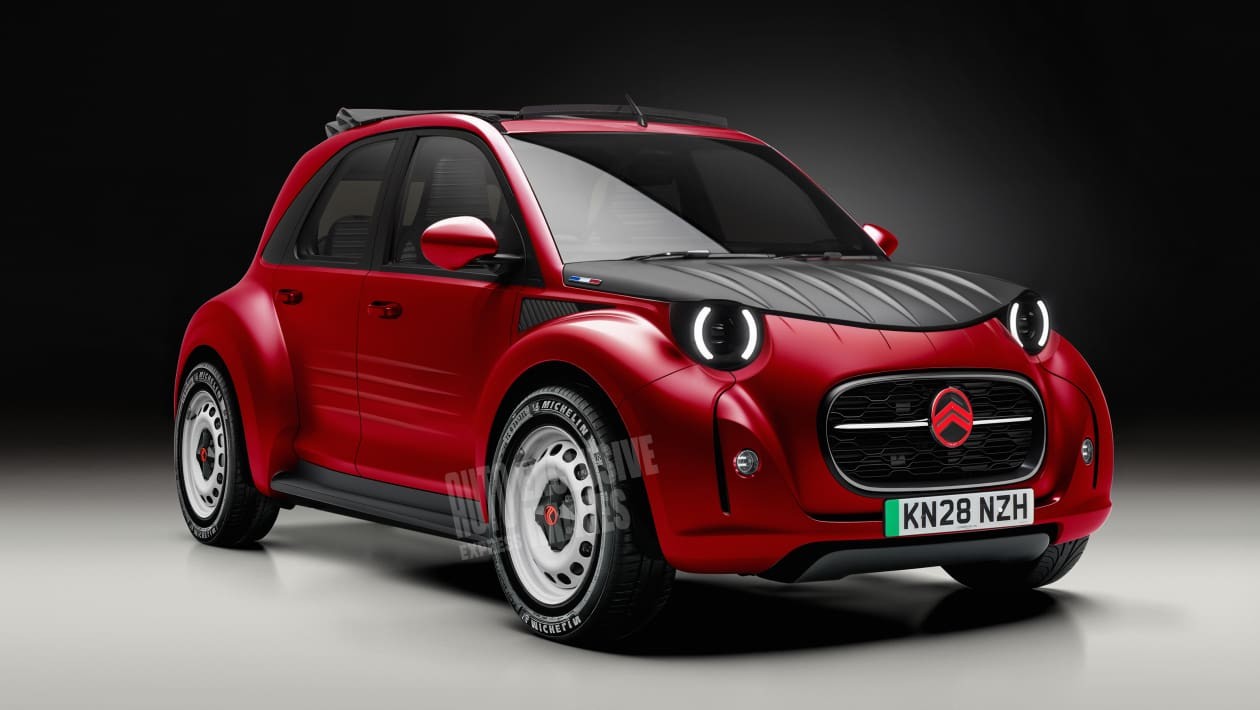
The ghost of the past has come back to life. The Citroën 2CV is returning in 2028. It will be fully electric. It might cost only £13,000? That is the claim, at least.
We have seen just one shadowy teaser. But the hints are strong. Xavier Chardon, the boss of Citroën, didn’t mince words during Stellantis’s investor talk in 2026: “Icons create emotion… the 2CV is back.”
Applause followed. Not polite clapping. The real kind. The crowd knew what was at stake. This isn’t a badge on a box. It is a resurrection.
The look matters
People were worried it would be a trick. A name tag slapped on some generic boxy EV. The teaser image put those fears to rest. It looks like a 2CV. Really does.
The wheelarches flare out. Round headlights poke forward. That tall horseshoe-shaped boot remains. Plain as day. It honors the form. The roof stays high, squeezing maximum space into a tiny footprint. It won’t hit four meters long. Smaller than a C3. About the same size as the new Renault Twingo and the upcoming Kia EV1.
“The 2CV will probably measure less than three meters, meaning it will be tiny but vast.”
Affordability. Lightweight design. Practicality. Chardon said it captures the soul of the original. “A true people’s car designed for real life,” he said. And he means it. “Made in Europe. Below €15,00.” The price point is key. It aims to democratize electric drive.
The concept drops in October at the Paris Motor Show. Assembly happens in Italy at Pomigliano d’Arco. Same factory making the Fiat Panda. Efficient use of space.
This move sits under Stellantis’s massive 60-billion euro plan called FaSTLAne. Brands like Jeep and Peugeot are launching fleets of new gear. The 2CV belongs to the “E-Car” project. A cheap tier for the entry-level electric market. Likely to replace the Fiat 500 in budget terms.
“Simple is intuitive,” Chardon added. “Complex doesn’t win the future. Relevance does.”
Not a time capsule
Pierre Leclercq leads design. He’s busy crafting this neo-retro hit. The Renault 5 proved it works. It’s already the best-selling EV in parts of Europe. People crave history wrapped in tech.
Leclercq looked at past attempts. The 2009 Revolте concept had ‘eye’ lights. A shortened DS3. It was cool, he said, but too much. This time around they tried smaller H-types. Different shapes. “You don’t have to stick to one path.”
But don’t expect a parody.
Chardon drilled the point home. Nostalgia isn’t a magic fix. It’s not enough. The point of the original was function. It carried farmers under a roof. It held fifty kilograms of potatoes. Today it carries a nurse. The job changes, not just the skin.
Size wise it mirrors that Twingo blueprint. Not exactly the Renault 5. But the DNA is clear.
The boring engineering bits
STLA One architecture isn’t coming here. A bespoke, low-cost “E-Car” platform holds the 2CV together. Different from the C3’s frame. Lower costs mean using Lithium Iron Phosphate (LFP) batteries.
Leapmotor, the Chinese partner, helps keep prices down. Stellantis wants European assembly for sure. And cheap materials where they count. The EU is pushing an M1E category right now. Rules aren’t final yet. Cars must be under 4.2 meters. Must be built inside the Union.
Stellantis teamed up with CATL for a factory in Spain. 4.1 billion euros on the table. Battery packs arrive late 2026.
Why rush? Cheap cars. The gap under 25,000 euros is huge. Three million people dropped out of car buying post-pandemic. Sixty percent? They blame the price tag.
“There’s nothing under 15,000 anymore,” Chardon admitted. The market is missing a pulse. He promised they are working to fix that hole.
Specs remain guesses, but the Twingo is the target benchmark. Roughly 80bhp. 27.5 kWh battery. Maybe 160 miles on a charge? It will fit neatly into those EU boxes if approved this year.
Production starts 2028? On track. If the regulators cooperate.
The past isn’t gone. It’s just charging up.