Ethanol. E85. Flex Fuel. It feels like the automotive industry threw a bunch of acronyms at us and hoped we’d just fill up anyway. If you’re staring at the pump wondering which nozzle won’t wreck your engine, you’re not alone. The push to cut down on fossil fuels has led to a confusing landscape of additives and blends.
Here is the raw truth about what’s in your tank and who can drink it.
The Corn-Based Solution
Automakers and fuel giants wanted a way to keep cars running strong while using less petroleum. They landed on ethanol. In the U.S., that means mostly corn. It’s a renewable, high-octane fuel that burns cleaner than straight gas.
This led to the creation of Flexible Fuel Vehicles (FFVs). These cars are engineered to handle a mix of unleaded gasoline and ethanol in concentrations ranging from zero up to 85 percent. That high-end mix? That’s what we call E85.
Most gas pumps today already have a little ethanol in them. But here is the hard line: only vehicles specifically badged as Flex Fuel can handle the E85 blend. No production vehicle runs on pure ethanol (grain alcohol). If your car isn’t built for it, you can’t force it.
Why It Burns Clean
Proponents argue these fuels are greener. Why? Because ethanol contains 35 percent oxygen. This oxygen helps the fuel burn more completely inside the cylinder. The result? Lower carbon monoxide emissions. It’s not a magic bullet for the environment, but it is cleaner than burning straight gasoline.
From the Track to the Pump
Ethanol isn’t just for suburban commutes. It’s taken over racing. By 2007, the Indy Racing League was using it. NASCAR followed suit, introducing “Green E15” across all three national touring series.
Indy cars actually switched from methanol to pure 100 percent ethanol, with plans to move to E85 by 2012. The engine components there are built to withstand the corrosion and energy density of the stuff. Your daily driver is not an Indy car.
Don’t Ruin Your Boat
This is where people get screwed.
Every consumer car and every FFV can run on pure gasoline. No problem there. But not every gasoline engine can handle E85. If you have an older vehicle, slapping E85 in it can eat through fuel lines and destroy seals.
And it’s not just cars. You need to be just as careful with motorcycles, ATVs, boats, personal watercraft, lawn mowers, and generators. These engines often lack the corrosion-resistant materials found in modern FFVs.
For these machines, stick to E10. Often called “gasohol,” this blend contains up to 10 percent ethanol. It is generally safe for older engines and small equipment. Anything higher risks damage.
Check Your Badge
Before you reach for the E85 nozzle, look at your fuel door. Does it say Flex Fuel? If it doesn’t, stay away from the high-percentage blends. You might save a few cents a gallon, but you’ll pay for it in repairs.
The technology is there
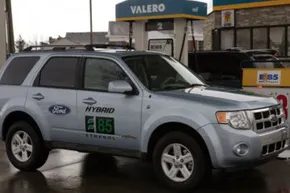

Spotting the Flex Fuel Badge
You want to know if your car can handle E85 without hurting the tank? Look at the gas cap first. If it’s bright yellow, you are likely in the clear. Some manufacturers skip the color code entirely, opting instead for a sticker inside the fuel filler door that spells out E85 or FFV (Flex Fuel Vehicle). It’s a quick visual check that saves you from pumping the wrong blend into a standard engine.
The trade-off is real. Ethanol has less energy density than pure gasoline. When you switch to E85, expect your miles per gallon to drop. We are talking about a 25 to 30 percent decrease in fuel economy. It’s a steep hit. The upside? The engine burns cleaner. Less soot. Fewer emissions at the tailpipe. For the environment, it’s a win. For your wallet and range anxiety, it’s a loss.
Even E10 blends—the standard gasoline you buy at most pumps—take a small toll. If you run E10, you might see a 3 to 4 percent dip in efficiency. It’s subtle. Barely noticeable in daily driving. But it’s there.
The Renewable Fuel Paradox
Ethanol comes from starch crops or cellulosic biomass. You ferment it. You distill it. It’s renewable. That’s the pitch. The goal is to cut the world’s reliance on petroleum. For now, it works as a partial substitute. It keeps some barrels of crude out of the ground. It supports agricultural sectors. It looks good on paper.
But the current U.S. administration has other priorities. Fuel economy standards are tightening. The EPA is pushing for higher numbers on window stickers. Automakers are under pressure. They need every mpg they can get. They are focusing on hybridization, aerodynamics, and lighter materials. They are not focusing on E85.
Why? Because E85 is inefficient. It fights against the very standards the government is enforcing. If a manufacturer optimizes a car for E85, the EPA ratings drop. That hurts sales. That hurts compliance. So, the industry is backing away. E85 is not the silver bullet for modern corporate average fuel economy (CAFE) targets. Not yet.
The Future of Ethanol
The technology exists. The fuel exists. The infrastructure is patchy. The economic incentives are misaligned. Automakers won’t push E85 when it costs them points on their efficiency scorecard. Consumers won’t buy cars that only run on it if the gas stations don’t stock it. It’s a chicken-and-egg problem.
For now, the yellow cap is a novelty. A niche option. You might find it in older models or specific work trucks. But don’t expect it to dominate the fleet. The push is toward electrification. Toward hybrids. Toward efficiency, not combustion cleanliness.
So, if you have a yellow cap, enjoy the cleaner burn. Fill up when you can. Drive slowly. Accept the range penalty. It’s a choice. One that looks good for the planet, but bad for the odometer.

The shouting match over ethanol is over. Or at least, the loud, chaotic marketing blitz that dominated the mid-2000s has faded into a near-total silence. You won’t hear executives championing E85 fuel during the next press conference. The PR nightmare of the early 2000s wasn’t just about octane ratings; it was geopolitical and agricultural. Competing with the image of a starving migrant farm worker while the price of tortillas skyrocketed due to corn-based biofuel mandates was a battle no automaker wanted to fight. The optics were terrible. The narrative was toxic.
Yet, if you look past the silence, the hardware remains.
Manufacturers did not scrap flexible fuel vehicles (FFV) because the technology failed. They kept them in the lineup because the infrastructure actually matured. This wasn’t organic growth. It was a targeted investment. Key players put capital into the pump network specifically to ensure that if you bought a FFV, you could actually use it. The stations are there. The supply chain holds. The marketing just stopped screaming about it.
The infrastructure for E85 survived not through consumer love, but through strategic industrial investment.
It is a strange footnote in automotive history that the first commercially available flexible fuel vehicle was built by Henry Ford. The Model T, released in 1908, was designed to run on gasoline, ethanol, or any blend of the two. Ford, a chemist at heart, knew that feedstock volatility was the enemy of mass production. He wanted an engine that could survive whatever fuel the country could grow or refine. He got it right over a century before the current biofuel wave crashed into the political reality of food vs. fuel.
We lost the hype. We kept the tanks. The question now is not whether the cars can run, but who actually bothers to fill them up.