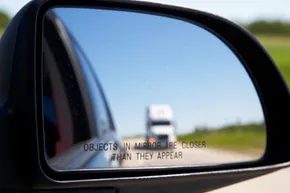
You think you have it figured out. You sit down, twist the little dial on your armrest, and call it a day. If that’s your routine, you’re also responsible for those heart-pounding moments on the highway where you signal to move left, check your mirror, and suddenly find a sedan occupying the exact space you intended to enter. They do not want to share. They seem to believe in a strict physical law against two vehicles occupying the same space, a law you are about to ignore.
That invisible zone near your fenders is the blind spot. It’s the rear flank area where a vehicle can hide from your center mirror and your side mirrors simultaneously. You see the car behind you in the center glass. You see it pass by your side window. But for a few critical seconds, it vanishes into a dimension your mirrors cannot reach. While some cars have larger blind spots than others, a poorly adjusted mirror can hide a full-sized truck just as easily as a compact. Technology exists to detect these gaps, but the most effective defense is still mechanical: proper mirror adjustment.
Why the Standard “See Your Car” Method Is Wrong
Most drivers adjust their mirrors to see a significant portion of their own vehicle’s side panel. This is the primary error. When you sit upright and can see your own fender in the mirror, your field of view is focused on your car, not the road. Your own rear fender is not a threat to your safety. It will never attempt a lane change on you. By wasting mirror real estate on your own vehicle, you are creating a larger blind spot for the traffic around you.
How to Adjust Driver and Passenger Side Mirrors
This technique requires no special tools, just a few seconds of awkward posture. It applies specifically to cars with electric mirror controls. If you have manual mirrors, you will need to open the window or ask a passenger to adjust the glass while you lean.
Step 1: The Driver’s Side Mirror
Lean your body to the left until your forehead touches the window glass. With your head in this position, adjust the driver’s side mirror until you can see just a sliver of your car’s side. The goal is minimal visibility. When you sit back up straight in your driving position, you should be able to see no part of your own vehicle in that mirror. Your entire field of view should be the road behind and to the left.
Step 2: The Passenger’s Side Mirror
Repeat the process for the right side. Lean across the center console until your head is hovering over the middle of the car. Adjust the passenger-side mirror until you see that same tiny sliver of your vehicle. Sit back up. Your own car should again be invisible in the glass.
How to Position the Center Mirror Correctly
The center mirror follows different rules. Do not lean. Sit in your normal driving position. If you are a sloucher, adjust for that posture. If you sit up straight on a particular day, adjust for that. The key is consistency with your actual driving habit.
Adjust the center mirror so that, when you glance up, you see as much of the rear windshield as possible. Avoid the temptation to angle it to flatter your profile or to hide a messy back seat. The mirror is for traffic awareness, not self-reflection.
Does This Work for All Vehicles?
This lean-head method is optimal for electric mirrors because it allows precise, small adjustments without leaving the seat. For manual mirrors, the process is clunkier. You may need to estimate the head position with the window down or have a friend stand outside to adjust the mirror while you hold your head in the correct position. While slightly less precise, the goal remains the same: minimize the visibility of your own car in the side mirrors to maximize the view of adjacent lanes.
Properly adjusted mirrors do not eliminate the need for checking over your shoulder, but they significantly reduce the size of the blind spot. You stop guessing where the car is and start seeing it. The next time you need to change lanes, you’ll have a clearer picture of who is already there. And they, unfortunately, will still not want to share.