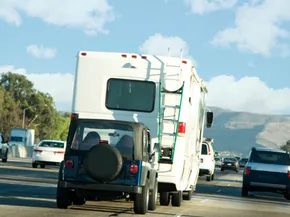
RV trips have survived the gas price spike because they solve the biggest headache of road tripping: where do you sleep? You park, you cook, you roam. But the moment you leave the interstate and hit a city, that same freedom becomes a liability. Your rig is too big for downtown sightseeing, and driving a 30-foot Class A to the grocery store is a nightmare.
So what do people do? They tow a car.
It sounds simple. Park the RV, hop into the car, go get coffee. The problem is the equipment. Traditional dollies and trailers are heavy, expensive, and require precise backing maneuvers that make most people want to quit driving altogether. Enter the self-aligning car-mounted tow bar.
How Self-Aligning Systems Work
This setup changes the geometry of the tow. Instead of a heavy dolly lifting the front wheels, a self-aligning system uses a bracket mounted to the vehicle being towed. The bar connects the RV to that bracket, but the mechanism allows the towed car to keep all four wheels on the ground.
The “self-aligning” part is the magic. You don’t need to perfectly align the hitch to the tow bar in a tight parking lot. You get the vehicles close, the bar swings or pivots into position on its own, and you’re hooked up. It removes the stress of millimeter-perfect hitching.
Advantages of Car-Mounted Hardware
Why mount the bar to the car instead of the RV?
- Weight distribution: The hardware stays with the towed vehicle. When you park the RV and disconnect, the bar moves with the car.
- Ease of connection: Self-aligning features mean you can hook up in spots where backing a dolly is impossible.
- Space efficiency: No dolly to store. The car remains a fully functional vehicle, just with a hitch point.
“The self-aligning feature allows users to get the RV and the vehicle being towed close together, then the bars move into the proper position themselves.”
This is huge for urban travel. You’re not wrestling a 300-pound dolly into a parking spot. You’re just linking two points.
The Trade-Offs
It’s not all smooth sailing. Car-mounted systems have downsides.
- Installation complexity: You have to drill and mount the bracket to the vehicle’s frame or bumper. If you switch cars often, this is a hassle.
- Vehicle compatibility: Not every car can handle the stress of being towed with all four wheels down. You need to check your owner’s manual for tow ratings.
- Braking integration: You still need to manage the towed vehicle’s brakes or use a brake controller. The tow bar doesn’t solve this; it just changes how you connect.
Which Setup Fits Your Trip?
If you’re doing a week-long loop through the Southwest, stopping in small towns and driving to museums, a car-mounted self-aligning tow bar is often the superior choice over a dolly. It saves gas on short hops and lets you navigate tight city streets without the RV in the mix.
But if you’re towing a heavy SUV or a car without a proper tow rating, you might be better off

Why Mounting on the Car Changes the Game
Think about the nightmare of hooking up two vehicles manually. One inch off and you’re wrestling with a steel bar, swearing, and wasting half an hour. Self-aligning car-mounted tow bars kill that friction. You don’t need pixel-perfect alignment. You just get close, and the mechanism does the heavy lifting.
That’s the core value prop. Ease of use isn’t just a marketing buzzword here; it’s the mechanical reality. These systems adjust dynamically to keep the towed car and the tow vehicle in sync, eliminating the guesswork that plagues traditional setups.
Weight, Fitment, and the Catch
Here is where it gets tricky. These bars mount to the car being towed, not the truck or RV pulling it. That placement makes them lighter than their tow-vehicle-mounted counterparts. A single person can handle them without a forklift or a buddy.
But “lighter” doesn’t mean “universal.”
- Compatibility is non-negotiable. You cannot slap these on any sedan or SUV. The mount points must match the specific chassis.
- Protection is often required. Many cars need skid plates or underbody guards. Without them, the tow bars can scrape or damage structural components during the alignment process.
The Hidden Costs of Convenience
Leaving the bars on the car is the biggest convenience factor. No unloading, no stowing in the trunk, no fumbling in the rain. Just pull up and go.
There is a price tag, though. It’s not just about the purchase price.
Fuel economy takes a hit. Extra weight on the rear axle means the engine works harder, especially on highway speeds. The drop is noticeable if you track your MPG.
Suspension wear accelerates. The constant, albeit small, load shifts stress on rear shocks and springs.
Accident severity increases. This is the point most people ignore. If that car is rear-ended, the tow bars are rigid steel structures protruding from the bumper. They can act as levers, increasing damage to the frame or crumple zone. It’s a trade-off for daily convenience versus safety margin.
Choosing the Right Hardware for Your Tow Setup
Do not guess. A generic bar might fit the frame rails, but it could be the wrong length, or have the wrong pin diameter. Check your owner’s manual for weight limits, but also talk to an RV dealer or a shop specializing in towing equipment. They match the specific model year and trim of your towed vehicle to the correct car-mounted self-aligning tow bar.
The hardware package usually includes three distinct components. The base plate or bracket bolts directly to the car’s chassis. Safety cables connect that bracket to the RV’s hitch. The brake light wiring kit integrates into the car’s electrical system. That last piece matters. When the RV hits the brakes, the towed car’s rear lights need to illuminate. If they don’t, traffic behind you has no idea you are slowing down.
Mounting the Base Plate and Wiring the Lights
The bracket goes on the front of the towed car. The exact bolt points vary by make and model, so follow the instructions from the tow bar seller precisely. Wrong placement risks damage to the bumper or structural failure under load.
Next comes the safety cables. These run from the car’s bracket up to the RV hitch. They are your backup if the tow bar fails.
The brake light wiring kit is a bit fiddly. It typically routes through the car’s fuse box. You are tapping into the existing brake circuit. If you are comfortable with a multimeter and a soldering iron, this is a one-person afternoon job. If you are not, do not force it. A professional installer will get it right and avoid shorts that blow fuses or start fires.
How the Self-Aligning Mechanism Works
Once the rig is assembled, the setup is straightforward. Pull the RV up, align the towed car, and connect the tow bar. Drive forward. As the RV moves, the self-aligning bars pivot into their locked position. This keeps the towed car at a consistent, safe distance behind the motorhome without the driver having to manually adjust the angle.
The bars lock in place automatically. That is the whole point. No constant steering corrections. No guesswork on angles. Just a rigid, predictable setup.
If your installation feels loose, or if the wiring connection to the fuse box seems unstable, stop. Tighten it. Recheck the connections. Safety is not a suggestion here. It is the baseline.