Automakers are busy flooding the market with sensors. Rear cross-traffic alert. Blind spot monitoring. Pedestrian and cyclist detection. It is a gold rush of safety tech that is finally becoming affordable for the average driver. But here is the hard truth: you cannot wait for your next car to save your life. You need to change how you interact with your current vehicle right now.
There is a method to reduce cyclist fatalities that requires zero electronics. It works in a 1998 Honda Civic and a 2024 Tesla. It costs nothing. It is called the Dutch Reach.
How the Dutch Reach Actually Works
Most people open their car doors with their left hand. It is intuitive. You reach down, pull the handle, and push. It is fast. It is lazy. It is dangerous.
The Dutch Reach flips this script. You must use your right hand to open the driver-side door.
Why does this matter? When you reach across your body, your torso rotates. Your head naturally follows. You are physically forced to look over your shoulder toward the rear of the vehicle. You cannot keep your eyes glued to your phone or your coffee while doing it. You catch your side mirror. You see the cyclist who has been approaching silently in the blind spot. You stop.
“Instead of flinging open the door with one hand and doing something else with the other, the Dutch Reach forces you to be more conscious of what you’re doing.”
It is a simple mechanical hack that creates a moment of awareness where there usually is none.
The Reality of “Dooring”
We tend to think car doors are harmless barriers. They are not.
In 2016, the United States saw 840 bicyclist fatalities. That number was up 1.3 percent from 2015. It was the highest death toll recorded since 1991. The National Highway Traffic Safety Administration tracks these numbers, and they are grim.
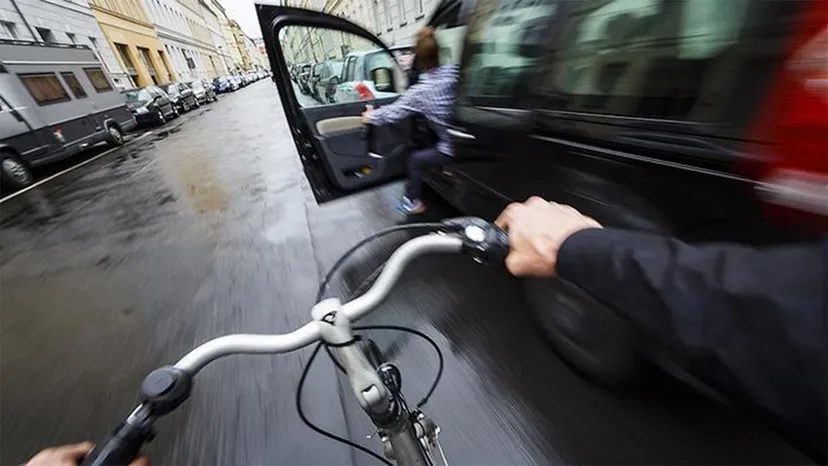
A study from Vancouver, British Columbia, highlighted a specific killer: dooring. When a cyclist crashes into an open car door, the impact is brutal. The car is stationary, but the cyclist is moving at speed. They go flying. The injuries are severe. The misconception that stationary objects are safe is lethal. Even if data on the Dutch Reach is still maturing, the incentive to avoid these collisions is absolute.
Why It Is Called the Dutch Reach
The technique is not new. It is standard practice in the Netherlands.
Dutch drivers grow up in a culture where bikes are everywhere. Opening the door with the far hand is second nature. It is taught in driver’s ed there. If you forget, the culture reminds you. It did not happen overnight. It took years of education and cultural shift. Other European municipalities eventually adopted it.
The logic holds up anywhere. If a behavior can save lives in Amsterdam, it can save them in Boston.
Institutional Adoption in the US
The push for this technique in the United States gained real momentum in 2016. Dr. Michael Charney founded the Dutch Reach Project after a 27-year-old nursing student died when she was struck by an open car door.
The response was immediate and legislative.
- Massachusetts was the first state to add the technique to driver training manuals. The fatality that sparked the project happened there.
- Illinois followed suit.
- By February 2019, Washington became the third state to include the Dutch Reach in its official state driver materials.
Peter Han, a survivor of a serious dooring crash in Washington, told the New York Times that this technique is like looking both ways before crossing a street. Basic. Common sense. Yet, we have forgotten it.
Making It Stick
Awareness is not enough. You need habit formation.
In early 2019, AAA and the National Safety Council began teaching the Dutch Reach in their driver safety classes. This is a massive signal. These organizations reach millions of learners. They are normalizing the behavior.
Retraining the brain takes time. The Dutch Reach Project estimates it takes about 30 days for the behavior to become automatic. They suggest a tangible reminder: tie a ribbon to the door handle. Every time you touch it, you must use the far hand. Eventually, the muscle memory kicks in. You open the door with your right hand without thinking.
The technology in our cars is getting smarter. But the most effective safety feature is still the driver’s willingness to look before they act.