Concept cars used to mean something.
Now? You see the phrase attached to some vaguely recognizable sedan that’s going to sit on a lot next month. A thin veil. Barely there.
But forget that for a second. Go back a bit. Before the safe choices took over. When “concept” actually meant a vehicle born from a designer’s wildest daydream. A test of limits. An explosion of imagination with no regard for budget sheets.
We’ve combed through more than eighty years of metal and paint. Just to be clear. This is only a scratch. The surface of an iceberg. There are plenty more, obviously.
But these? These changed the game.
The Y-Job
People argue about titles. Sure, Volvo had the Venus Bilo back in ’33. So technically, they got there first.
Harley Earl didn’t care about technicalities.
He cared about the Buick Y-Job. Finished in ’39. It made him a legend. Why? Because it looked like nothing else on Earth. Hidden headlights. Electric windows. A roof that powered up or tucked away behind a hard cover. It whispered exactly where American car design was heading. Straight toward the post-war era.
It wasn’t a prototype. It was a promise.
LeSabre
Earl did it again in ’51. The Buick LeSabre.
Optimism you could drive. The jet age wasn’t just in the sky; it was in the garage. This thing sat a foot lower than the average family sedan. A V8 engine pumped out 335 horsepower. It had tailfins. Big ones. Wrap-around windshields.
Rain came? The roof closed automatically.
It set the template. For a decade, America’s Big Three followed suit. Everyone wanted fins. Everyone wanted to look fast standing still.
Ford XL500
Ford tried to make driving effortless in ’53 with the XL500. Push-button transmission. Just push a button. Done.
Too much glass was the issue. Like driving in a goldfish bowl. Hot. Sweaty. So Ford installed air conditioning. Emerging tech then, essential now.
Did you notice the built-in jack? For flats.
They also put in a telephone.
Who were they calling from inside the car?
Alfa Romeo BAT 5
America wasn’t the only place playing with shapes.
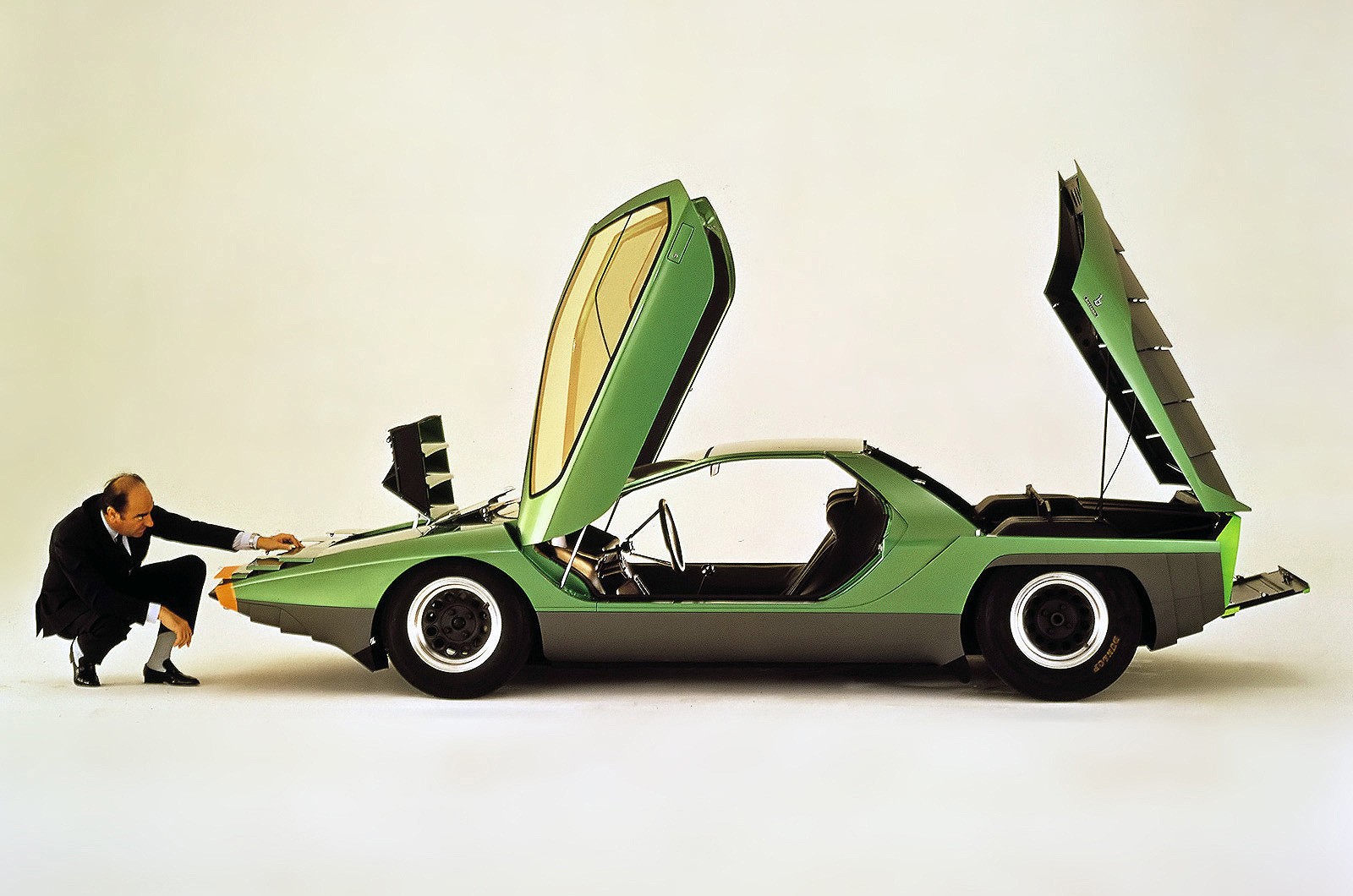
Italy was having its moment. Bertone was designing like a man possessed. The Alfa Romeo BAT 5 in ’53 is arguably the most striking of the bunch.
Extreme aerodynamics. They didn’t just want it to look low; they wanted it to slip. The drag coefficient? Just 0.23. The weight? Light. Around 1,100 kg.
The engine? Modest. Only 100 bhp.
Yet it hit 120 mph. The math worked because the design did. The next year’s BAT 7 got it down to 0.19. That is physics yielding to art.
Wildcat II
The Buick Wildcat II arrived in ’54. A “flying wing” front end. Glassfibre construction. It looked alien compared to the steel boxes rolling off lines.
Look closely at the center.
See it? The lineage to the original Corvette.
It appeared the same year as that first ’Vette. The connection isn’t accidental. It’s DNA. The Wildcat was a car from the future that arrived right on time to inspire what came next.