It opens today. Or it’s already open, depending on your timezone.
CATL just switched on its Xiamen Energy Storage Validation Institute. ESVL. Sounds corporate. It’s not. It’s huge. Ten hectares. Roughly 441 million dollars.
The goal is simple but ambitious: one-stop shop for testing the world’s energy storage. An open platform. For everyone. Not just for CATL’s own batteries, but for the whole industry.
Here’s why they needed it. The energy transition isn’t a slow glide. It’s a sprint. And people are stumbling. One in five big storage stations is underperforming. Nearly half are sitting in grid-connection limbo for more than two months. Delays pile up. Trust evaporates.
CATL says component-level testing isn’t enough anymore. You have to test the whole station. The messy reality.
“Scientific rigour is more critical now. We’re in the gigawatt era. ESVL helps usher in real-world validation that we can actually trust.” — Dr Wu Kai, CATL Chief Scientist
Dr Wu speaks like a man tired of theoretical safety. He wants proof.
ESVL isn’t one lab. It’s five. Each one tackling a different nightmare scenario.
Grid Integration : First of its kind for station-level tests. They’ve got a 35kV/1 over 100MVA simulator. It runs more than ten large storage containers at once. Simulates a grid with a thousand nodes. Chaotic? Yes. Accurate? Hopefully.
High-Voltage Safety : Voltage from 1kV up to 500kV. They poke and prod until things catch fire. Or explode. They want to see how it breaks under extreme duress.
Thermal and Combustion : A 20MW calorimeter sits inside 100,00 cubic meters of space. It tests explosions. Nine large containers at once. Think of it as controlled destruction.
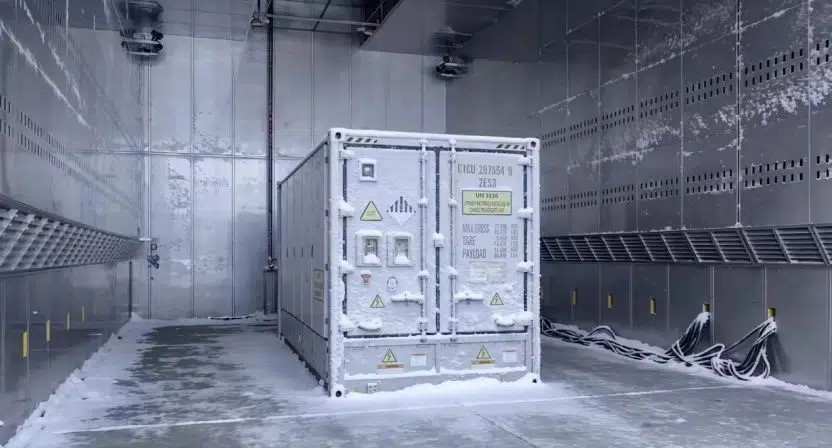
Environmental Reliability : How does your battery behave in the Arctic? Or a desert oven? The lab swings from -50C to 100C. They simulate altitudes up to 7.200 meters. Because the real world is brutal.
EMC : This is rare. The only place globally that does full electromagnetic compatibility testing on an actual 40-foot container while it charges and discharges under high power. Most tests use mockups. This uses steel.
Why go this hard on testing?
Money. And safety.
Dr Chen Xiaobo runs the show at ESVL. He points to partners like TUV SUD and TUV Rheinland. Big names in certification. By providing data that’s independent and traceable, they’re trying to make energy storage “bankable.”
Regulators want this data. Insurers need it. Banks are cautious.
If a battery station is predictable. If it’s proven to survive heat and grid shock. It’s an asset. Not a gamble.
The question is whether the market will catch up. Will insurers lower their rates based on these rigorous tests? Will developers wait two extra months to get validated instead of rushing into failure?
CATL built the tool. Now the industry has to use it. Or keep burning money on failures.
It’s up to them.