


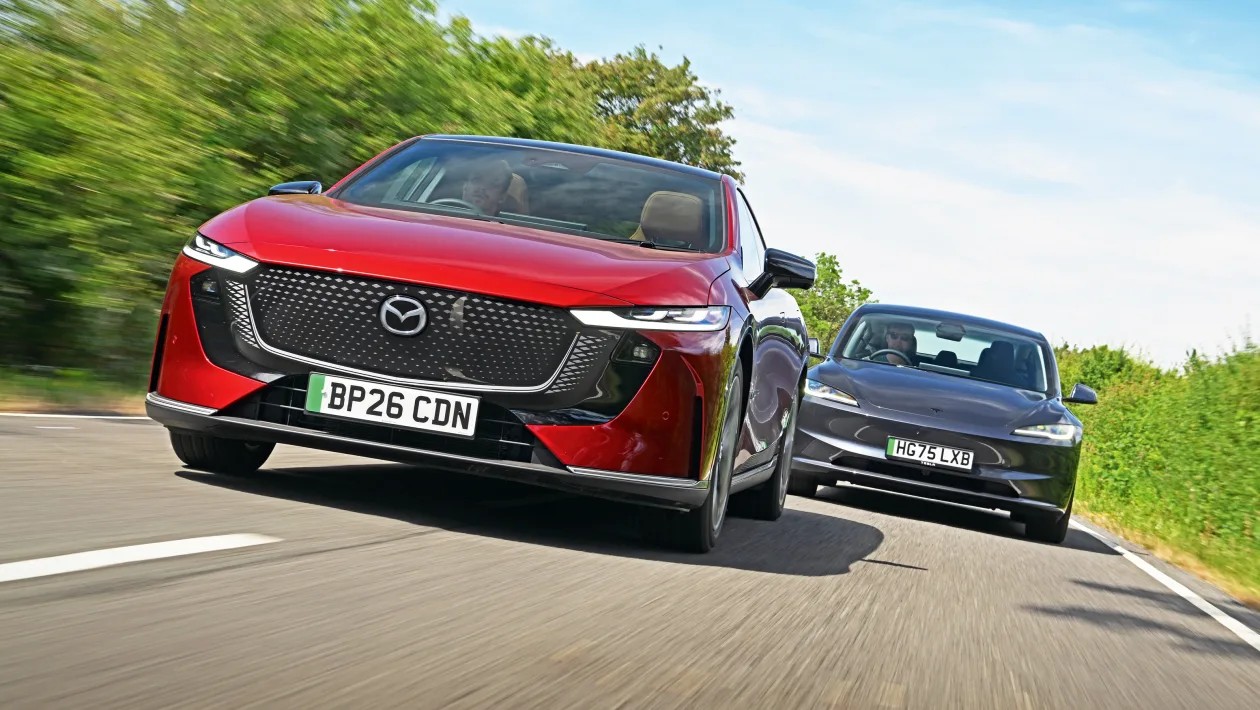
The electric car market was predictable for a while. You bought a Tesla Model 3 because it just worked. It was the default. The safe bet. The one that didn’t require a manual.
But time moves on. Rivals get better. The gap narrows.
Enter the Mazda 6e. A Japanese brand trying to reclaim ground. But here is the twist that most headlines miss. This isn’t really a Mazda.
It is a Chinese co-production. Built in China with Changan Automobile. Replacing the petrol-powered saloon of old, the 6e is now a five-door hatchback. It looks like a Mazda. It drives with a Mazda badge. But does it feel like the spirit of the MX-5?
Spoiler: It doesn’t.
Here is the brutal truth about why the Tesla Model 3 retains its crown, even against this sleek, plush newcomer.
How does the Mazda 6e compare to the Tesla Model 3 on paper?
On spec sheets, they are close. Too close for comfort if you are a Tesla loyalist.
The Mazda 6e 78kwh Takumi Plus starts at £38,995. The entry-level Tesla Model 3 Rear-Wheel Drive (RWD) sits slightly lower at £37,990.
But look under the hood—or the floor mats.
Tesla Model 3 RWD
– Battery: ~62.5kWh
– Power: 279bhp
– 0-62mph: 6.2 seconds
– Official Range: 332 miles
– Test Efficiency: 4.4 miles/kWh
Mazda 6e Takumi Plus
– Battery: 78kWh
– Power: 254bhp
– 0-62mph: 7.9 seconds
– Official Range: 348 miles
– Test Efficiency: 3.9 miles/kWh
The Mazda has a bigger battery. Yes. It gives it 16 more miles of official range. But the Tesla is more efficient. In real-world testing, the Tesla extracted more mileage per kilowatt. That matters when you are driving between charge stops, not just sitting still looking at a menu.
Is the Mazda 6e interior better than the Tesla?
Mazda sells on soul. On design. The 6e tries to deliver that with a plush cabin.
There are leather and suede finishes. Headrest speakers for the driver so you can take calls without annoying your passengers. Ambient lighting modes. Even an external speaker for when you are camping. It feels premium. Expensive, even.
“The interior will get a thumbs up from passengers.”
Tesla? It’s basic. Plastic. Textiles. It feels like a spaceship waiting room. Or a minimalist’s nightmare.
But function wins over form here.
The Tesla’s screen is 15.4 inches. It is responsive. Once you learn where things are, it works. The Mazda uses a 14.6-inch screen. But it is buried. Dozens of scrolling menus. Sub-menus within sub-menus. Want to change the wipers? Go digging. Or use one of two shortcut buttons on the steering wheel.
Two buttons.
For everything else.
If you map “lights” to shortcut button 1, you can’t map “defrost” to it. The controls on the left stalk are stripped back. No light controls. No wiper speed. You have to use the touchscreen. Or the shortcuts. It is a fundamental flaw. A usability sin.
Tesla has no stalk for wipers or lights either. But the interface is faster. It just knows what you want. The Mazda makes you think. You don’t want to think while driving.
Which car is better to drive: Tesla or Mazda 6e?
This is where the Mazda 6e falls apart.
Mazda built its reputation on driving dynamics. The MX-5. The Mazda 3. Cars that twist your spine and make you smile.
The 6e is heavy. 2,015 kg. It wallows in corners. It feels like a boat. Comfortable? Yes. Plush? Yes. Fun? No.
The Tesla Model 3 weighs less (1,768 kg). It handles better. The ride is firm, sure. But it connects to the road. The steering has feedback. The powertrain calibration is smoother.
You want an EV that feels like a car? Get the Tesla. You want an EV that feels like an appliance? The Mazda fits that bill, unfortunately. It feels like a generic Chinese EV wearing a badge. And that stings for Mazda fans.
Why the Tesla charging network still wins
Range anxiety is mostly dead. Charging anxiety is real.
The Mazda 6e charges faster on paper. 195kW max. 30-80% in 20 minutes. Tesla is 175kW. Slower.
But speed means nothing if the charger doesn’t work. Or isn’t there.
Tesla’s Supercharger network is the gold standard. It just works. Plug in. Drive away. The billing is seamless. You don’t need an app. You don’t need to scan a QR code.
Mazda drivers will rely on third-party networks. Pod Point. Ion. BP Pulse. Some are fine. Some are broken. Some require a credit card on file and a 15-minute unlock timer.
The ease of Tesla charging negates the Mazda’s longer range. Why do you need 348 miles if you can top up in 15 minutes anywhere?
Safety and ownership: Who covers your back?
Tesla’s safety systems are sharper. The lane assist doesn’t wrestle the wheel away from your hands every time you pass a pothole. The cameras provide a clear, accurate view.
The Mazda 6e’s lane assist is hypersensitive. It jerks the steering. On country roads, this is dangerous. Annoying is a polite word. It is intrusive.
Ownership costs tell a similar story.
Tesla includes servicing for three years if you finance. No cost. No hassle. Mobile Service comes to you. Over-the-air updates fix issues without a dealer visit.
Mazda offers a six-year warranty. Longer than Tesla’s four. That is a plus. But roadside assistance is only three years for Mazda, four for Tesla. And who knows what “TBC” means for Mazda service costs? Tesla charges £0 for three years.
The Verdict
It should have been closer.
The Mazda 6e is a beautiful car. Inside and out. It has more range on paper. A plush interior. A longer warranty.
But it lacks the heart.
It lacks the driving joy. The usability. The simplicity. It feels like a compromise. A brand trying to jump on the EV bandwagon but forgetting why people bought Mazdas in the first place.
The Tesla Model 3 remains the better daily driver. It is more fun to drive. Easier to live with. Safer on the highway. And the charging experience is years ahead.
The Japanese newcomer takes on EV royalty. The royalty remains seated.
The 6e is a good car. A nice car. But it is not a Mazda car.
And in 2024, that distinction matters more than battery size.
Which one would you drive?
“The 6e simply feels like a ChineseEV wearing Mazda badges.”


