
You would switch to a fuel that emits nothing but water vapor in a heartbeat. That is the promise. And for the most part, it is true. Automakers are actively engineering systems that let us replace gasoline with hydrogen. It is abundant. It leaves a smaller environmental footprint than petroleum.
There are two main paths for this technology. One involves converting existing internal combustion engines to burn hydrogen on demand. The other uses fuel cells to generate electricity. Both aim to solve the same problem. But the hype has created a vacuum. Scammers are rushing in to fill it.
The Chemistry of Clean Driving
All these technologies rely on the same basic principle as your daily commute. Chemical energy stored in fuel. Released through reaction. With gasoline or hydrogen in a traditional engine, that reaction is combustion. You burn it. The heat turns into mechanical energy that moves the pistons.
Fuel cells work differently. They do not burn anything. They combine hydrogen with oxygen from the air. This chemical reaction skips the heat phase. It generates electrical energy directly. That electricity then powers an electric motor. It is a simplified view. The engineering under the hood is far more complex. If you want the nitty-gritty, check out guides on how car engines work or how fuel cells operate.
But let’s be clear. You cannot simply turn your sedan into a water-powered vehicle with a cheap kit. We are going to look at the real science behind fuel cell vehicles and hydrogen internal combustion engines. We will also dissect those recent ads promising a simple conversion to run your car on water. Spoiler. They are lies.
Is Hydrogen Actually Safe?
Hear “hydrogen car” and most people see the Hindenburg. The image of a fiery disaster sticks. It is a major hurdle. The public perceives hydrogen as volatile. Automakers insist it is as safe as gasoline. They try to prove it with tests and safety protocols. It rarely convinces the skeptics.
The proof is in the enforcement. When BMW tested the Hydrogen 7, the restrictions were immediate and severe. New York Times auto critic Lawrence Ulrich tried to drive the prototype through the Lincoln and Holland tunnels. He was stopped. The Port Authority of New York and New Jersey did not allow it. Why? Because the tunnels have strict regulations regarding hydrogen vehicles. The fear was real enough to shut down a test drive.
This perception issue slows adoption. It does not mean the technology is flawed. It means people are afraid of the tank.
Hydrogen-on-Demand
The concept sounds simple enough. Create hydrogen inside the car. Mix it with air. Burn it. This is the “on-demand” approach. It repurposes existing internal combustion engine architecture. You do not need a new electric drivetrain. You do not need to overhaul the entire supply chain immediately.
However, the efficiency drops. Generating hydrogen on board requires energy. That energy comes from the fuel itself or an onboard reformer. It is a complex dance. You lose energy in the conversion process. Still, for legacy manufacturers, it offers a bridge. A way to keep internal combustion relevant while reducing tailpipe emissions.
“There are a number of scams trying to capitalize on the demand for clean energy technologies.”
But before you get excited about retrofitting your older model, remember the safety barriers. The infrastructure does not exist for widespread hydrogen distribution. And the public still associates the element with explosion risks. The path forward is not just about engineering. It is about trust. And right now, that trust is fragile.
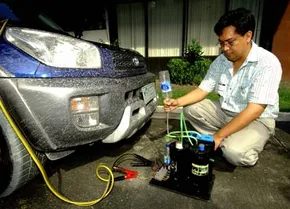

Let’s clear up the terminology right away. When people talk about “hydrogen-on-demand,” they aren’t talking about a single technology. It generally splits into two distinct camps: systems designed to feed fuel cells and setups built for internal combustion engines (ICE).
The aftermarket industry is flooded with claims. You’ll see ads for kits promising to convert your daily driver into a hydrogen-powered beast. Most of these are what we call hydrogen-on-demand systems acting as gasoline additives. Enthusiasts often refer to this as hydrogen fuel enhancement or direct hydrogen injection.
Here is how the hardware usually works. You take water. H2O. One oxygen atom, two hydrogen atoms. You pass an electrical current through it, sometimes with a chemical catalyst added to the mix. The specific electrolyte varies by brand, but the goal is always the same: break the molecular bond to create HHO gas.
This mixture of oxygen and hydrogen is technically known as oxyhydrogen. In certain circles, particularly among inventors and early researchers, it gets called Brown’s Gas, named after Yehuda Smith, who popularized the concept of electrolyzing water for energy.
The gas is routed into the engine’s intake manifold. It joins the fuel-air mixture. The theory, as pitched by the manufacturers, is that HHO acts as a combustion catalyst. It supposedly lowers the burning temperature of the gasoline. Cooler burn. Less friction. Higher efficiency. Lower emissions.
It sounds logical. It also doesn’t hold up under scrutiny.
“Powering a car with water would be nearly impossible.”
The marketing materials often claim you are driving on water. That is a lie. You are driving on gasoline or diesel. The water is merely a reactant. The energy comes from the chemical breakdown of the water molecule and the combustion of the fossil fuel.
Chemical reactions release energy by shifting bonds from a higher state to a lower state. Water is the sink. Its bonds are incredibly stable. To split H2O into H2 and O2 requires a massive input of electrical energy. The electrolysis process is energy-intensive.
Here is the math problem that kills the business case for these kits. The amount of electricity drawn from your alternator and battery to produce the HHO gas exceeds the marginal gain in fuel efficiency. You are spending more energy to create the additive than you are saving at the pump. It is a net loss.
These systems don’t power your car. They tax your electrical system. They may slightly alter the combustion profile, but they do not change the fundamental thermodynamics of the engine.
But this isn’t the only game in town. While aftermarket hacks struggle with basic physics, the big manufacturers are taking a different path. They aren’t trying to trick the engine with water. They are building dedicated hydrogen infrastructure.
Hydrogen-Powered Cars

The Liquid Hydrogen Reality Check
There is a massive technical gap between saying a car runs on hydrogen and actually making it work. Take the BMW Hydrogen 7. It’s an internal combustion engine capable of burning both gasoline and hydrogen. But don’t picture a standard tank. This car uses liquid hydrogen. That means keeping the fuel at cryogenic temperatures. If the heat rises, the hydrogen turns into gas. And gaseous hydrogen cannot power the engine in this specific configuration.
The modifications required aren’t just under the hood. They are in the fuel system. Insulating a tank to keep liquid hydrogen cold demands serious engineering. It’s not a simple swap-out.
Engine Tolerances and Conversion Myths
Car engines are precision instruments. They are built for specific operating conditions and fuel properties. You’ve seen it with octane ratings. Putting low-octane gas in a high-performance engine hurts performance. It’s like eating nothing but licorice. You can do it. It won’t end well.
The BMW Hydrogen 7 isn’t a standard engine running weird fuel. It’s an engine built for hydrogen. Sophisticated computer systems monitor every cycle to ensure optimal operation.
So, could you convert your current car? Technically, yes. Anything is possible in physics. Practically? It’s unlikely. The tolerances required for hydrogen combustion are far beyond a standard retrofit.
The Infrastructure Void
Even if you cracked the engineering code, you need fuel. Where do you get it?
Hydrogen fueling stations are scarce. In the United States, California is essentially the only state with a functional network. That’s it.
You might think about home refueling. Some systems tap into natural gas lines and convert the methane into hydrogen. It’s an option. But it adds complexity to an already complex problem. You’re not just buying a car. You’re building a chemical plant in your driveway.
The Road Ahead
Reliable hydrogen fuel technology is still in development. The promise is real. A renewable resource that cuts harmful emissions. But the hurdles are significant.
Automakers are moving forward with fuel cell technology. Hydrogen-powered vehicles may become widespread soon. Or they may not. The timeline is uncertain.
One thing is certain. The “water-powered” cars that promise miracles on the internet will never hit the showroom floor. They are scams. The science doesn’t support them.
For deeper dives into the mechanics, look up how fuel cells work or how the hydrogen economy is structured. The path to alternative fuels is long. And it’s paved with engineering challenges, not magic.