You see the headlines constantly. Every time a new hybrid drops or gets a minor update, the press goes wild over a fractional efficiency gain. It is marketing fluff. Pure and simple. But don’t roll your eyes at it. When it comes to saving energy and cutting emissions, every small margin of improvement actually matters. The math doesn’t lie.
Yet, while the industry was busy polishing chrome and tweaking fuel maps, a German engineer named Dr. Hüttlin was working in the shadows. His team at Innomot AG had been at this since before hybrids went from “sneaky technology” to “cool factor” to “boring standard.” Their result is so bizarre it feels like science fiction. It is a spherical aluminum engine. A ball. That runs your car.
The kugelmotor debut
It hit the main stage at the Geneva Motor Show in March 2011. While other booths showed off plug-in cables and battery packs, Dr. Hüttlin’s display featured a shiny, globular engine block. It drew a crowd. People wanted to know how a sphere could possibly work as a combustion engine.
The science behind the Hüttlin Spherical Engine seems solid, even if the shape defies conventional automotive logic.
We need to suspend disbelief here. A sphere has no pistons. No crankshaft. No camshafts. It is a radical departure from the internal combustion engine (ICE) we have used for over a century. But if you can accept the premise that a round engine is viable, the stats are surprisingly impressive. The device, often called the kugelmotor, promises to bridge the gap between pure electric vehicles (EVs) and traditional gas cars in a way no one saw coming.
Why range extenders matter
The core problem with early EVs wasn’t just the battery chemistry. It was the infrastructure. You couldn’t plug in everywhere. You couldn’t fill up in three minutes. This created “range anxiety.” The fear that your car would die in the middle of nowhere.
A range extender solves this. It is a small generator on board that charges the battery while you drive. You get the zero-emission drive of an electric motor. You get the instant torque. But you also have a backup gas engine that kicks in when the juice gets low.
The Hüttlin engine is designed to be the ultimate range extender. It improves on typical hybrid efficiency. It is lighter. It burns fuel more cleanly. It reduces the environmental impact per mile. By removing the fear of being stranded, it could force the market to accept electric vehicles on their own terms.
How the spherical design works
Most engines are linear. Pistons move up and down. Cranks convert that motion into rotation. This creates vibration. Mechanical loss. Heat.
The Hüttlin engine uses a different approach. Inside the spherical chamber, a rotor spins. There are no reciprocating parts. This means less friction. Less weight. The combustion happens in a more controlled, continuous manner.
It is not just a gimmick. The thermal efficiency is higher than traditional engines. The exhaust emissions are lower. And because it is so compact, it can be paired with a large battery without taking up the trunk space or adding excessive weight to the chassis.
The state of hybrid tech
We are at an inflection point. Hybrids are selling well. EVs are selling well. But both have flaws. Hybrids still rely on gasoline. EVs still rely on scarce charging networks. The Hüttlin engine offers a middle path. It is a renewable energy solution that doesn’t require you to change your driving habits.
Did anyone expect a ball to replace the piston? Probably not. But if the physics hold up, this might be the missing link for mass-market electrification. The engine debuted in 2011. Development has been slow. The skepticism is high. But the potential is there.
If this technology scales, the definition of a “hybrid” changes. It stops being a compromise. It becomes a superior option. The question is whether Innomot AG
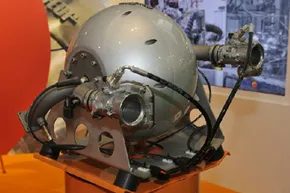
Most people would look at a spherical engine and assume it was a prop from a sci-fi budget cut. It looks goofy. It looks unstable. It looks like it would rattle apart the moment it touched a piston.
But Dr. Hüttlin didn’t design the Hüttlin Spherical Engine to stand alone. He designed it to be a range extender.
That distinction matters. A range extender isn’t the primary muscle in a hybrid. It’s the backup generator. It kicks in when the battery dips below a certain threshold, spinning a generator to feed electrons back to the electric motor. This setup is what separates a plug-in hybrid from a pure electric vehicle (EV). Without it, you’re tethered to a charger. With it, you get range.
Range anxiety is the single biggest barrier to EV adoption. The Hüttlin Spherical Engine was built to solve that problem with a geometry that defies conventional automotive engineering.
How Traditional Range Extenders Work
To understand why a ball is better than a block, you have to look at what we currently use. Early hybrids relied on internal combustion engines (ICE). A gas engine spins a shaft. That shaft turns a generator. The generator makes electricity. The electricity powers the wheels.
It’s inefficient. There’s friction. There’s heat loss. There’s vibration.
Modern hybrids have refined this. Some prioritize fuel economy by keeping the gas engine off as much as possible. Others keep it running at a constant, optimal RPM to maximize generator output. Most still use reciprocating pistons and crankshafts because that technology is cheap and well-understood.
But that setup is bulky. It requires a cooling system. It needs oil changes. It’s heavy.
Dr. Hüttlin looked at that and asked: Why does a generator need to look like a car engine?
The Spherical Design: Form Over Tradition
The Hüttlin Spherical Engine abandons the crankshaft. It abandons the cylinder block. It uses a sphere.
The concept is simple. The sphere rotates within a housing. As it spins, it acts as both the motor and the generator. There are no pistons moving up and down. There is no reciprocating mass to balance. The motion is purely rotational.
This creates a few immediate advantages for a range extender:
- Compactness: The engine is self-contained. It doesn’t need external linkages.
- Lightness: Fewer moving parts mean less metal.
- Smoothness: No explosions. No vibrations. Just spin.
- Cost: Simpler manufacturing if you can figure out the seals.
Hüttlin’s goal was to create a unit that was light, compact, and cheap. Not a high-performance powerplant, but a reliable utility device. A range extender shouldn’t waste space. It shouldn’t weigh down the chassis. It should sit there, hum quietly, and keep the battery alive.
Why the Sphere?
Critics call it whimsical. Engineers call it a return to first principles.
Traditional engines are inefficient because they convert linear motion into rotational motion. That conversion loses energy. The spherical design skips the conversion. It is rotational from the start.
“The Hüttlin Spherical Engine reflects the thinking that a range extender shouldn’t squander the hybrid’s resources.”
This isn’t a new idea. Spherical engines have been theorized for decades. But Hüttlin’s iteration is one of the few that has moved past the whiteboard and into actual functional prototyping. The design challenges established norms: How do you seal a rotating sphere? How do you handle the heat? How do you manage the torque?
These are hard questions. But the potential payoff is a range extender that fits in a smaller package, weighs less, and operates with fewer failure points than a standard micro-gas engine.
The Trade-Offs
It’s not all smooth sailing. The spherical design introduces new engineering hurdles. Sealing a rotating sphere against a stationary housing is difficult. Wear patterns on spherical bearings are complex. And while the theory is clean, the reality of manufacturing precision can be expensive.
Yet, the alternative is sticking with the status quo. Reciprocating engines are heavy. They are noisy. They emit pollutants even when they
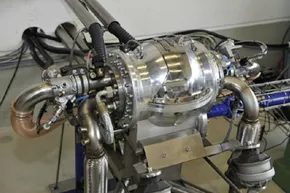
Let’s skip the preamble about hybrid power-sharing matrices. It’s a distraction. To actually understand what the Hüttlin is doing, treat it as a stand-alone internal combustion engine. Just imagine the output. Where that energy goes once it leaves the block is irrelevant to understanding the machine itself. The mechanics are confusing enough without worrying about the drivetrain.
Here is the baseline. The current prototype churns out roughly 104 horsepower. That number isn’t the headline. The headline is scalability. Dr. Hüttlin claims you can scale this design to fit almost any power requirement modern automotive engineering demands. While current models are liquid-cooled, the architecture supports air-cooled setups too.
The simplicity of construction is where the efficiency gains hide.
This engine contains about 60 components. An average four-cylinder piston engine has roughly 250. Fewer parts mean fewer things to break, assemble, or manufacture. That reduction in complexity drives the thermal efficiency up to more than 30 percent.
Think about that stat.
Traditional internal combustion engines operate at roughly 20 percent efficiency. That means 80 percent of the energy in your fuel tank vanishes as heat, noise, and wasted friction. With the Hüttlin, less than 70 percent of the potential power is squandered. Less fuel burned. Fewer emissions. You pay less at the pump and the planet breathes a little easier.
But the physics? That’s where it gets weird.
Inside the Silver Sphere
Dr. Hüttlin calls the movement “three-dimensional kinematics.” It burns gasoline. It has pistons. But after those two facts, you are in uncharted territory.
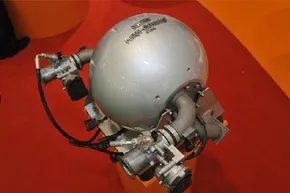
Look at the prototype. It’s a silver aluminum ball with pipes sticking out of it. It looks like a prop for Spaceship Earth at Epcot. How does a sphere encase a combustion chamber?
Inside that lightweight globe are kugels. They run in tracks. Those tracks sit inside two pistons on the same bearing. Those pistons sit inside a rotor. That rotor spins within the outer aluminum shell.
As the rotor turns, the pistons pump in opposition. The kugels glide along their tracks. That gliding motion spins the rotor.
It sounds like a jumble of terms. Piston. Rotor. Bearing. They share names with parts you know, but their roles here are completely different. Don’t let the nomenclature fool you.
Power Transfer and Timeline
Coils and magnets inside the sphere generate electricity. This power transfers outside the shell to batteries. These aren’t the primary traction batteries. They act as temporary holding packs. They smooth out the power delivery for the drivetrain.
From there, the energy goes to another motor. This motor drives the wheels directly. No traditional transmission. No driveshaft. Innomot AG says this direct drive setup is significantly more efficient than routing power through a gearbox.
Dr. Hüttlin spent decades refining this concept. The patents were filed in December 2010, adding to a portfolio of over 150. Innomot AG plans to license the technology. That means you likely won’t see a car with a Hüttlin in the dealership lot tomorrow.
The expectation is production vehicles within two to five years. The tech is ready. The engineering is sound. The question is whether any major manufacturer will risk their engine bay on a silver ball that defies every intuitive assumption we have about how an engine should work.
We’ll see.