We’ve been chasing horsepower since the internal combustion engine first roared to life. The brute-force solution is simple: make the engine bigger. But large displacement comes with baggage. It adds weight. It burns more fuel. It costs more to build and keep running. Sometimes, bigger isn’t better.
The smarter play is efficiency. You take a standard-sized engine and force it to breathe harder. You cram more air into the combustion chamber. More oxygen allows you to inject more fuel. More fuel means a more violent explosion. More explosion means more horsepower.
Enter the supercharger.
This device is the primary tool for forced air induction. It’s not just a gimmick. It’s a mechanical necessity for drivers who want immediate throttle response without waiting for exhaust gases to spin up a turbine. In this article, we break down exactly what a supercharger is, how it manipulates pressure, and how it differs from its exhaust-driven cousin.
A supercharger is any device that pressurizes the air intake to above atmospheric pressure.
Technically, both superchargers and turbochargers perform this same function. In fact, the word “turbo” is just a lazy shortening of “turbo-supercharger.” They share a goal. They diverge in execution.
The fundamental difference lies in the energy source. A turbocharger is passive. It uses the waste energy from exhaust gases to spin a turbine, which then compresses the incoming air. A supercharger is active. It is mechanically linked to the engine’s crankshaft via a belt or chain. The engine drives it. The engine pulls the power from its own output to push more air into itself.
It’s a direct trade-off. You get instant response, but you pay for it in parasitic loss.
Before we dive into the mechanics of how these impellers and screws actually move air, a quick clarification. When we talk about superchargers here, we mean the mechanical forced-induction system for gasoline engines. We are not discussing Tesla’s proprietary charging network. That’s a different kind of “super” entirely.
Supercharger Basics
The intake stroke is deceptively simple. A piston drops. A vacuum forms inside the cylinder. Atmospheric pressure, hungry to equalize, forces air into the combustion chamber. That air is just waiting for its partner. Fuel enters the mix, creating the charge. That’s potential energy. It sits there, inert, until the spark plug fires. Combustion begins. Oxidation rips through the fuel, releasing thermal energy. The pressure spikes above the cylinder head. The piston is slammed down. That linear motion travels through the crankshaft, eventually turning your wheels.
More power requires a bigger explosion. Bigger explosions need more fuel. But you can’t just dump extra gas into the cylinder. Stoichiometry matters. You need oxygen to burn the fuel. At idle or highway cruise, the engine runs a lean 14.7:1 air-fuel ratio. One part fuel, fourteen point seven parts air. When you punch the throttle, that ratio drops. Maybe 12:1. You’re running rich to maximize power.
Want to run that rich mix? You need more oxygen. You need more air. That’s exactly what a supercharger does.
Compressing Air for More Power
A supercharger forces air into the engine at pressures higher than the surrounding atmosphere. No vacuum required. It’s positive displacement. The result is a denser charge. Denser charge means you can inject more fuel. More fuel and more air mean more torque and horsepower. The gains are measurable. On average, you’re looking at a 46 percent jump in horsepower and a 31 percent increase in torque.
This is particularly useful in high-altitude environments. Thin air means less oxygen. Engines choke up. A supercharger compensates by compressing that thin air, delivering a dense, high-pressure charge to the cylinders. Performance stays consistent regardless of elevation.
The Mechanical Link
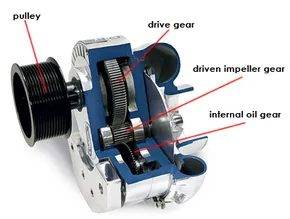
Here is where it differs from a turbocharger. Turbos use exhaust gases to spin a turbine. Superchargers are belt-driven. They draw power directly from the engine’s crankshaft. An accessory belt wraps around a pulley connected to a drive gear. That gear spins the compressor gear. Inside, rotors or screws trap air, squeeze it into a smaller volume, and dump it into the intake manifold.
The math is unforgiving. To pressurize air effectively, the compressor must spin faster than the engine itself. The drive gear is larger than the compressor gear. This gear ratio creates speed. The compressor can hit 50,000 to 65,000 RPM. Fast enough to blur your vision.
At 50,000 RPM, you’re looking at a boost of 6 to 9 psi. That’s pounds per square inch above atmospheric pressure. At sea level, atmospheric pressure is 14.7 psi. Add 9 psi of boost, and you’re packing about 50 percent more air into the engine than it would normally ingest.
The Heat Problem
Compression generates heat. Physics doesn’t negotiate. Hot air expands. It’s less dense. Less dense air contains fewer oxygen molecules per cubic inch. Fewer oxygen molecules mean a weaker explosion. If you feed hot, supercharged air directly into the engine, you lose efficiency. You waste the compression work you just did.
The solution is the intercooler. It cools the compressed air before it hits the intake manifold. There are two main types: air-to-air and air-to-water. Both function like radiators. Coolant or ambient air flows through a matrix of tubes. Hot air from the supercharger passes over or through these tubes. Heat transfers. The air cools.
Cool air is denser. Denser air means more oxygen. More oxygen allows for more fuel. More fuel creates a hotter, more powerful explosion. The cycle completes. The engine makes power.
Roots Superchargers
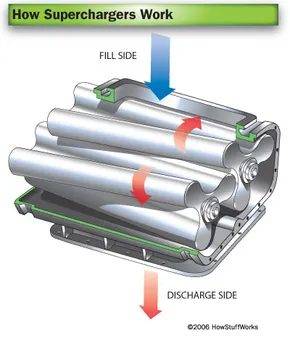
The oldest design. The Roots blower. It doesn’t compress air inside the housing. It traps it. Two lobed rotors spin in opposite directions. They scoot air from the inlet to the outlet. The compression happens downstream, in the intake manifold. It’s simple. Reliable. Cheap to make. But it’s inefficient. It pushes a lot of air, but a lot of that energy goes into heating the charge rather than increasing pressure. Still, it provides instant throttle response. No lag. Just power.
Roots: The Original Air Blower
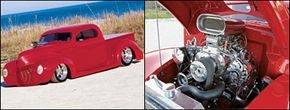
Roots units are the classic choice for look, not efficiency. You see them everywhere on hot rods and muscle cars because they demand attention. They sit high on the engine bay, often forcing the hood to stay open. But behind that theatrical stance lies a design that’s older than your grandfather’s car. Philander and Francis Roots patented the concept in 1860. It wasn’t for speed. It was for mine shaft ventilation. Fast forward to 1900, and Gottleib Daimler slapped one into a car engine. The tech had arrived.
The mechanics are simple. Two lobed rotors spin inside a housing. They mesh but don’t touch. As they rotate, air gets trapped in the spaces between the lobes. The rotors shuttle that air from the intake side to the exhaust side. No compression happens inside the unit itself. The air just gets shoved into the intake manifold in chunks. That sudden influx creates positive pressure. It’s a displacement blower. That’s why the term “blower” stuck. It’s essentially an air pump with a fancy name.
There’s a catch. They are heavy. And they are inefficient. Because they move air in discrete bursts rather than a smooth stream, they waste energy. A Roots supercharger is the least efficient type available. If you’re chasing horsepower per dollar, look elsewhere. If you want the sound and the stance, it’s hard to beat.
Twin-Screw: Efficient and Compact
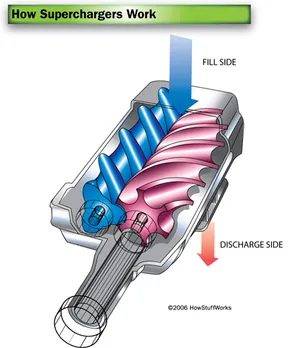
Twin-screw superchargers solve the efficiency problem. They look like two screws wound together. Interlocking lobes compress the air as they rotate. Unlike the Roots design, compression happens inside the housing. This means less weight, smaller footprint, and significantly better thermal efficiency.
They are more complex than Roots units. The rotors must be timed perfectly. But the result is a smoother power delivery. No more bursts. Just steady, continuous boost. This makes them ideal for street-driven vehicles where driveability matters. They don’t stick out of the hood like a Roots unit. They tuck away neatly, often integrated directly into the intake manifold.
Which is better? For pure horsepower at the track, a large Roots unit might win on volume. For a balanced street car, the twin-screw is the smarter engineering choice. It’s the middle ground between brute force and precision.
How Twin-Screw Superchargers Actually Work
Unlike the Roots blower that just shoves air into the intake, a twin-screw supercharger compresses the charge inside the housing itself. It uses two meshing rotors with helical lobes that twist around each other. As they spin, they trap pockets of air. But here is the difference. The rotors are conical. They taper from the inlet to the outlet. This means the space inside each pocket shrinks as the air moves through the unit. The volume decreases. The pressure increases. It is positive displacement compression happening in real-time.
This design is mechanically superior for efficiency. It moves more air with less parasitic loss than a Roots system. But precision manufacturing makes them expensive. The tolerances between the rotors and the housing are tighter than on almost any other forced induction component. If the parts aren’t perfect, the supercharger fails. Or it makes a sound like a jet engine.
They often sit on top of the engine bay. The design resembles a Roots blower in layout. But the noise profile is different. The high-pressure discharge creates a distinct whine. It is a high-pitched scream that cuts through the cabin. Builders have to wrestle with this sound. You need insulation. You need careful routing of the intake piping to dampen the frequency. Without it, the cabin becomes an uncomfortable place for long drives.
Centrifugal Superchargers
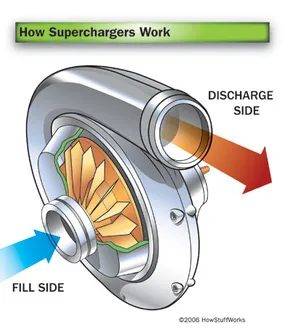
The logic flips when you look at centrifugal superchargers. They don’t trap air in pockets. They throw it. Inside the housing sits a compressor wheel. It looks like a turbine. It spins at thousands of RPMs. As the wheel rotates, it pulls air into the center. Centrifugal force pushes the air outward toward the housing walls. The air speeds up. The pressure builds. The velocity increases.
This is dynamic compression. It works more like a turbocharger than a blower. There is no mechanical connection between the shaft and the wheel. A belt drives the input shaft. The gear reduction inside the unit spins the compressor wheel much faster than the engine. Typical ratios are 3.3:1. Some units go up to 8:1 or higher. The faster the wheel spins, the more air it throws.
The efficiency curve is where this design shines. At low RPMs, a centrifugal supercharger produces little to no boost. It feels like a stock engine. You get natural aspiration. As the engine speed climbs, the boost ramps up linearly. It peaks at the top of the rev range. This matches the way naturally aspirated engines behave. Many enthusiasts prefer this feel. It doesn’t hit you in the chest at idle. It builds as you open the throttle.
There is a trade-off. The power delivery is delayed. You have to wait for the RPMs to climb before the boost kicks in. It lacks the instant throttle response of a roots or twin-screw unit. You can feel the lag. It is not turbo lag. There is no exhaust gas to spool. It is simply inertia. The heavy flywheel and the compressor wheel take time to accelerate. Until they do, you are just spinning metal.
Noise is different here too. It is a high-frequency whine. It sounds like a jet engine taking off. It is less of a mechanical whine and more of an aerodynamic howl.
The Mechanics of Boost
Inside the casing, a rotor-like impeller spins at terrifying speeds—often hitting 50,000 to 60,000 RPM. It sucks air in through the center hub. Centrifugal force throws that air outward against the walls of the compressor housing. The result? The air exits the impeller at blistering velocity but relatively low pressure.
That changes immediately at the diffuser. This ring of stationary vanes surrounds the spinning impeller. When the high-speed air hits these fixed blades, it slows down. Physics takes over: as velocity drops, pressure spikes. The diffuser converts kinetic energy into static pressure, delivering dense, compressed air to the engine.
Why Centrifugal Rules the Street
Among all forced induction methods, centrifugal superchargers are widely considered the most efficient. They are compact, light, and bolt onto the front of the engine rather than sitting on top. This layout keeps the center of gravity low and the hood line sleek.
They also have a distinct personality. The high-RPM whine is unmistakable. It sounds like a jet engine spooling up, a sound that turns heads whether you are at a stoplight or a car meet.
Manufacturers know this appeal. Several 2021 models came equipped with these units straight from the factory. The Jaguar XF, Dodge Charger, Volvo S90, and Ford Mustang all featured OEM centrifugal superchargers. They offer that forced-induction punch without the bulk of a traditional blower.
DIY Boost and Drag Racing
You don’t have to buy a new car to get this performance. Aftermarket kits are readily available for a wide range of vehicles. Many companies sell complete installation packages that include all necessary hardware. It is a feasible do-it-yourself project for those with mechanical aptitude.
This customization is foundational in the world of funny cars and fuel racers. Enthusiasts modify stock engines to survive extreme pressures. It is not just about speed; it is about engineering reliability under stress.
While some manufacturers bolt these on at the factory, others leave it to the aftermarket community to drive innovation. The barrier to entry has never been lower. You can walk into a shop, point at a car, and leave with significantly more power.
The Power of Pressure
Why do enthusiasts prefer this method over turbochargers? The answer lies in the delivery. A centrifugal supercharger provides linear power. As you press the gas, the boost builds progressively. There is no lag. No waiting for exhaust gases to spin a turbine. When you want power, it is there.
This direct connection changes how you drive. You feel every ounce of compression. The engine breathes easier at high RPMs, unlocking horsepower that stock intakes simply cannot access. It is a mechanical link between your foot and the piston.
Is it the only way to add boost? No. Turbos are more thermally efficient in many scenarios. But for immediate throttle response and that signature whine, the centrifugal supercharger remains a top choice.
The trade-off? It draws power from the crankshaft. There is a parasitic loss. You are spending some of that gained horsepower just to spin the blower. But for many drivers, the trade-off is worth it. The instant surge of power feels raw. It feels real.
We are just scratching
Why bolt-on boost beats exhaust-driven spool
The headline benefit of slapping a supercharger on a stock engine is instant, tangible horsepower. It transforms a mundane daily driver into a machine that feels like it hides a much larger, more powerful V8 or V6 under the hood. But when you are standing in a parts store aisle, torn between a supercharger vs turbocharger setup, the decision gets messy. Enthusiasts argue until their knuckles bleed. Engineers shrug. The truth? Superchargers offer distinct advantages that turbochargers simply cannot match in specific scenarios.
The most glaring win is the absence of lag.
Turbochargers suffer from lag because they rely on exhaust gas velocity to spin a turbine. That takes time. You press the pedal. The engine breathes. The exhaust builds pressure. The turbine spins. Then you get power. Superchargers bypass this delay entirely. They are driven directly by the crankshaft via a belt or chain. Press the gas, the compressor spins, air gets forced into the combustion chamber, boom. Instant throttle response.
Not all superchargers act the same, however. Roots and twin-screw units deliver their punch at low RPMs, making them feel visceral in city traffic or during low-speed passes. Centrifugal superchargers, on the other hand, mimic turbo behavior by becoming more efficient as the impeller spins faster, peaking their power at higher RPMs. You choose your personality.
Installation and maintenance reality check
Think about the labor involved. Installing a turbocharger often requires welding, custom exhaust piping, and extensive modification to the exhaust system. It is a messy, invasive process. A supercharger? Often, it is a bolt-on affair. You mount it to the top or side of the engine, connect the belt, and you are mostly done. This makes them significantly cheaper to install and vastly easier to service.
Maintenance habits have changed over the decades, too. Old-school turbo owners had to let their engines idle for 30 seconds before shutting them down to prevent oil coking in the turbo bearings. Modern turbos have automated oil circulations systems that handle that for you, allowing you to kill the ignition the moment you park. Superchargers don’t have that specific thermal shock issue, but they do demand a proper warmup. They operate most efficiently at normal operating temperatures, so cold-starting and immediately flooring it is a recipe for premature wear.
Interestingly, this mechanical simplicity is why superchargers are standard equipment on many aircraft engines. Planes fly at altitudes where the air is thin and oxygen is scarce. A supercharger mechanically forces that thin air into the combustion chamber, allowing the aircraft to climb higher without losing engine performance. The principle is identical to the automotive version: crank-driven compression, no reliance on exhaust flow.
The cost of free air
Here is the catch. Everything has a price. The biggest disadvantage of a supercharger vs turbocharger debate is also its defining characteristic. Because the supercharger is mechanically linked to the crankshaft, it consumes energy to spin. It steals horsepower from the engine to create boost.
We are talking about a significant tax on power. A supercharger can consume as much as 20 percent of an engine’s total output just to run itself. You might wonder if this trade-off makes sense. Consider the offset: a typical supercharger can generate 46 percent additional horsepower. Even after paying that 20 percent “tax,” you are still netting a massive gain. Most enthusiasts decide the trade-off is worth it.
But the strain doesn’t stop at the drivetrain. Supercharging puts immense pressure on engine components. The explosions inside the cylinders are bigger, harder, and hotter. If you bolt a supercharger onto a weak, stock engine block, you might as well be throwing money out the window. The engine will likely fail.
Manufacturers know this. That is why supercharged engines come with heavy-duty internals—stronger pistons, reinforced crankshafts, and upgraded cooling systems. This durability comes with a price tag. Supercharged vehicles cost more to buy. They cost more to maintain. And they demand high-octane premium fuel to prevent detonation, which adds up at the pump.
Is the boost worth the bucks?
Despite the higher upfront cost and maintenance requirements, superchargers remain one of the most cost-effective ways to drastically increase horsepower. We are talking about power increases ranging from 50 to 100 percent depending on the setup. For racing, towing heavy loads, or simply wanting an adrenaline spike every time you merge onto the highway, the return on investment is hard to ignore.
A supercharger won’t necessarily make your car faster in a straight-line quarter-mile time compared to a well-tuned turbo (which can spool up to immense pressures), but it makes the car feel faster. The acceleration is linear, immediate, and brutal.
So, is a supercharger worth the money? It depends on what you value. If you want max peak horsepower and fuel efficiency at cruising speeds, a turbo might win. If you want instant throttle response, easier installation, and a linear power curve that feels like a bigger engine, the supercharger is the king. But remember, you are paying for that immediacy with more horsepower stolen from the crank and more money spent on premium gas.
The technical breakdown
How does a supercharger work?
It pressurizes the air intake to levels above atmospheric pressure. Unlike a turbo, which uses exhaust flow, a supercharger is powered mechanically by a belt or chain drive connected to the engine’s crankshaft.
How much horsepower does a supercharger add?
Expect a boost in engine output between 30 and 50 percent on average. While the supercharger consumes about 20 percent of power to run, the net gain usually lands around a 46 percent increase in total horsepower.
Are superchargers worth the money?
They offer a direct trade-off. You get increased horsepower and a driving experience that mimics a larger engine. But you accept increased power consumption to drive the unit and added strain on the engine components, which requires higher maintenance and better fuel.