Gas is bleeding us dry. Household budgets are tighter than drumheads.
You want to stop watching your fuel gauge drop with panic in your eyes. There’s a fix. Hybrids. They give you petrol power without the heavy carbon guilt, or at least the lighter wallet bill.
Usually you pay a premium for electric bits. Not anymore. Fuel prices have pushed the break-even point so close it’s practically touching your rear bumper.
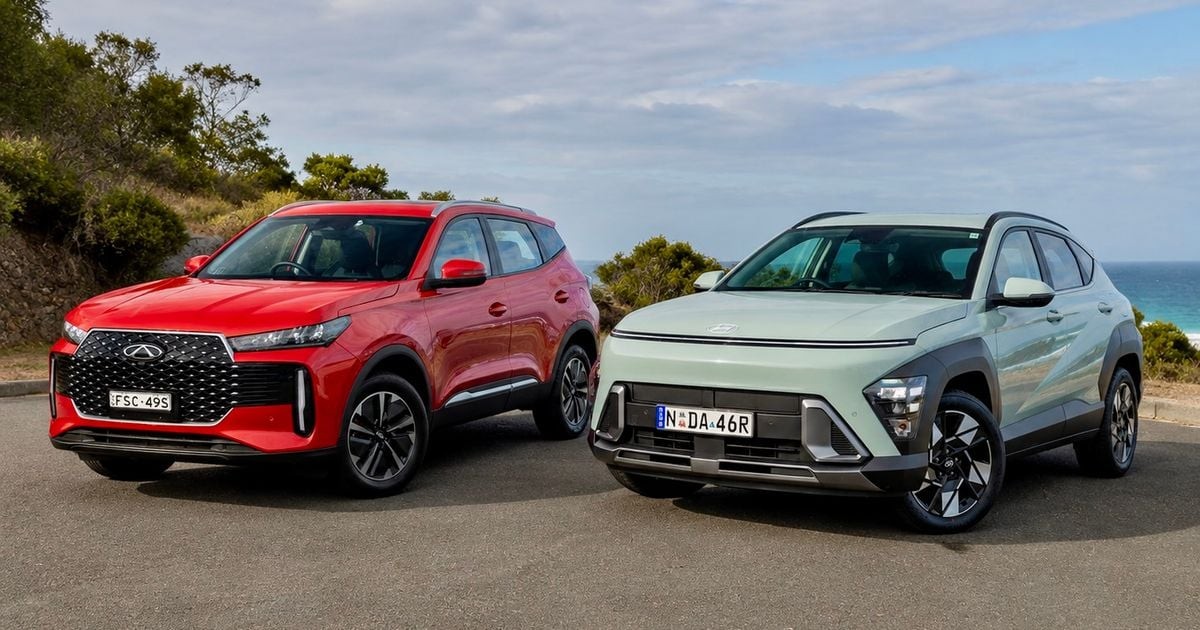
So let’s talk small SUVs. Specifically two fighters in the ring: the Chery Tiggo 4 Hybrid and the Hyundai Kona Hybrid.
On paper who wins?
Price and Spec Warfare
Here’s the first punch. The Chery Tiggo 4 starts at $29,999 drive-away in Australia. The cheapest? It’s the entry-level Urban. The Hyundai Kona starts over $10,00 more. Ouch.
But prices lie. Or at least they distract. To keep it fair we have to look at the Chery Tiggo 4 Ultimate (top tier) against the Hyundai Kona (entry tier). That’s how the real value story plays out.
What do they share? Plenty.
- 17-inch alloy wheels
- LED lighting all round
- Keyless entry and push-start
- Dual-zone climate control
- Touchscreens for media
- Bluetooth and wireless charging
Boring lists aside the interior story gets interesting. The Kona keeps things simple. Cloth seats. Manual adjustment. The Chery throws money at leather. Heated seats for the driver. Power adjustment. Ambient lighting that lets you set the mood.
The screens are a weird trade. Chery has a 10.25inch infotainment screen but matches it with a 10.25 digital instrument cluster. Hyundai has a massive 12.3 screen but relies on a old-school gauge cluster with a tiny 4.2 TFT insert in the middle.
Then there is the connectivity tax. Hyundai includes Bluelink. You can lock the car. Honk the horn. Track the location. All from your phone. Over-the-air updates included. Chery leaves you alone. Mostly.
Safety: Stars Matter
Hyundai boasts a four-star ANCAP rating across the board. Seven airbags. Standard issue.
Chery? Complicated. The non-hybrid Tiggo 4 got five stars. Same structure. Same bones. But the hybrid version? “Unrated”.
Technically they share safety gear. Autonomous braking. Lane keep assist. Blind spot monitoring. Door-open warnings. But that lack of an official safety star on the hybrid model stings. Does it matter? Maybe.
Unrated does not mean unsafe. But it means no data to back the claim.
Interior Real Estate
Dimensions don’t lie but they feel deceptive.
The Hyundai Kona is 4330mm long. The Chery Tiggo 4 is 4325mm. A five millimetre difference. Meaningless right?
Wrong. The Kona has a longer wheelbase. 2660mm versus 2604mm. That extra space stretches the cabin.
Both fit five. Both have boots. The aesthetics? Chery looks digital-heavy. Twin screens on dash. A huge climate screen below. Piano black trim that screams fingerprint magnet. It gets dirty fast.
The seats are high. Good for command view. Bad for tall people. Your thighs hang unsupported.
Storage? Cleverly hidden. The console looks empty but slide it back to find the wireless charger. The Kona is cleaner. A gear stalk on the steering wheel opens up the centre console. More space for junk. USBs for the rear passengers too.
Cargo space is a different fight. Hyundai claims 407L for the Kona boot. Chery says 470L for the Tiggo. That’s a decent chunk more luggage space in the Chinese car.
Spares? Hyundai gives you a space-saver tyre on every trim. Chery saves money here too. Only the top tier Ultimate gets a spare. The cheaper model gets a repair kit. Fix the hole yourself.
Under the Bonnet
Both are hybrids. Front wheel drive. Electric motors paired with petrol engines.
The Chery Tiggo 4 runs a 1.5 litre engine (71kW) mated to a strong electric motor (150kW). Total system output isn’t stated but the electric punch is there. Fuel use? 5.4L/101km. A tank range of 944km.
The Hyundai Kona has a slightly bigger engine. 1.6 litres. (77kW). But its electric motor is weaker. Only 32kW. Total combined output is 104kW. It uses a six-speed dual clutch.
This is where the numbers flip.
Hyundai drinks 3.9L/1km. Wait, that’s per 100km. Yes. 3.9. Against Chery’s 5.4. That’s nearly 30 percent better. With a tiny 38 litre tank it still stretches to 974km.
Why the gap? The Chery’s system is newer and punchier. The Hyundai is older tech refined to sip fuel like a hawk.
Running Costs
Seven years warranty. Unlimited kilometers. For both.
Caveats apply. You must service the Hyundai at a Hyundai dealer to keep the full seven-year coverage. Do it elsewhere and it drops to five years. Chery offers seven years regardless of where you go (assuming they honour the policy, always read the fine print).
Roadside assistance? Hyundai gives it for life if you service there. Chery matches the warranty period only. Seven years.
The killer blow? Servicing costs.
Hyundai : $4,331 over seven years. About $619 a year.
Chery : $2,519 over seven years. About $360 a year.
Do the math. Chery is significantly cheaper to own on paper. But you pay at the pump more often because of the higher fuel consumption.
The Verdict
Here is the tension. Do you trust the name on the badge? Or the value on the spec sheet?
The Hyundai Kona feels right. It’s polished. Modern. Spacious. Efficient. It drinks almost nothing. If fuel savings are the primary goal the math favours the Korean car. The better fuel economy likely eats into those high servicing costs over time.
The Chery Tiggo 4 offers more. Leather. Tech. Boot space. And it costs less upfront. Cheaper to service. But it thirstier.
So.
Do you save a few hundred dollars a year in repairs or buy a ticket for cheap petrol for years?
There’s no single right answer. Just two very different paths.