Most drivers assume that when they crank the steering wheel, both front tires point in the exact same direction. They don’t.
That’s a mistake waiting to happen.
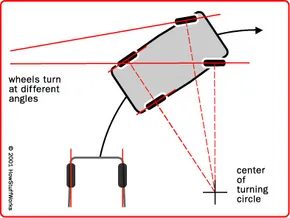
If both wheels turned at the same angle, the tires would scrub against the pavement. You’d feel it as resistance. The car would push forward instead of pivoting. The inside wheel needs to cut a tighter arc than the outside one. The outside wheel traces a wider circle. Simple geometry.
Imagine drawing a line perpendicular to the center of each tire. Those lines meet at a single point on the ground. That’s the instantaneous center of rotation. It’s the pivot around which the car swings. To make this happen, the steering linkage has to do some heavy lifting. The tie rods are angled. They push the inside wheel deeper into the turn than the outside wheel. This setup is called Ackermann steering geometry. It ensures the tires roll naturally without fighting the road surface.
You won’t see this mechanism in every car on the road. Manufacturers use different gearboxes to translate your hand movements into wheel motion.
Rack-and-Pinion Steering
This is the standard setup for modern vehicles. A pinion gear sits at the end of the steering column. It meshes with a linear gear bar called the rack. Turn the wheel. The pinion rotates. The rack moves left or right. This linear motion pulls the tie rods, angling the wheels. It’s direct. Responsive. Compact. Most front-wheel-drive and many rear-wheel-drive cars use this system.
Recirculating Ball Steering
You’re more likely to find this in older trucks or heavy-duty SUVs. The steering column connects to a sector gear. Inside the gear box, a worm gear spins. Ball bearings roll between the worm and the sector gear to reduce friction. As the worm turns, it moves the sector gear, which pulls the pitman arm. This connects to the center link and tie rods. It’s robust. It handles high loads. But it feels vague compared to rack-and-pinion. There’s more play. Less feedback.
Both systems achieve the same goal. They make the inside wheel turn sharper. They keep the car tracking smoothly through a corner. One is precision-focused. The other is built for durability.