Prosperity felt endless in 1928. The newly minted Chrysler Corporation had just bought Dodge, launched the DeSoto, and introduced the Plymouth. It was a triple threat. Good times didn’t last. The crash came. DeSoto was one of the few pre-Depression “expansion” brands to survive the hard times, though it nearly didn’t.
The brand built its most exciting cars in the ’50s. It died in late 1960. A flash recession and sibling rivalry destroyed its narrow price niche. In between, DeSoto acted as the medium-price bridge between Dodge and Chrysler. Engineering leaned heavily on Chrysler. Design usually did too.
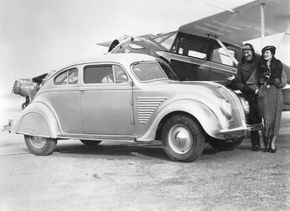
Early DeSotos sat just above Plymouth in size, power, and price. They didn’t settle into that middle-middle role until the late ’30s. DeSoto history largely paralleled Chrysler’s. There was one key exception. Chrysler offered conventionally styled Sixes for 1934. DeSoto relied exclusively on that year’s radical Airflow. The result was a sales disaster. It briefly threatened DeSoto’s existence.
The Orthodoxy of the Early Years
1930-33 DeSotos reflected general Chrysler Corporation trends. Styling was bolt-upright formal through 1931. Then it smoothed out. Barrel-like grilles appeared. Sixes and eights were available through 1931. All were orthodox side-valve designs with cast-iron construction. The five-main-bearing eight was smoother than the four-main six. Neither was a powerhouse.
Eights cost around $1,000. Early-’30s Sixes ran $800 to $850. Eights appealed to only one in three buyers. DeSoto dropped them entirely in 1932. It offered nothing but sixes until the hemi-head “FireDome” V-8 arrived in 1952. The six was essentially a smaller version of Chrysler’s six. It was periodically enlarged.
DeSoto started the ’30s in the middle of the industry pack. It moved upward through 1933. Volume totaled some 32,000 for 1930-31. Then it fell below 25,000 for ’32. The tally dropped under 23,000 for 1933. DeSoto climbed from 15th in a field of 31 makes to 10th out of 26.
To reflect this decline, DeSoto cut prices for 1933. A standard sedan or coupe started at $665. The top-line Custom convertible sedan hit $875. All models carried an 82-horsepower 217.8-cubic-inch six. This became a 100-horsepower, 241.5-cid engine for 1934-36. After that, a destroked 228.1 with 93 or 100 horsepower took over.
The six-cylinder DeSoto was sturdy and reliable, happily running for long spells with little maintenance other than an occasional quart of oil.
The Airflow Fiasco
Though never exciting, the DeSoto six was sturdy. It returned up to 22 mpg with gentle use. These traits made later six-cylinder DeSotos quite popular as taxicabs.
DeSoto first observed a model year with the January 1932 introduction of its SC-Series “All New Six.” It wore chunky but attractive styling. Available as a standard sedan, seven-passenger sedan, and Custom sedan, it also came as a convertible and phaeton. Additional coupes and a new brougham two-door sedan arrived for ’33.
All the pros and cons of the 1934 Chrysler Airflow applied to the DeSoto versions. They came in a single four-model series versus a multiplicity of Chryslers. Output bottomed out to a prewar low of just under 14,000 units.
Following Chrysler in a hasty retreat from Airflows, DeSoto introduced more-conventional “Airstream” styling for 1935. It appeared on seven companion models. They bore a Plymouth-like raked grille, slab sides, and a rounded deck.
Sedans were sold with either an outside spare tire or “trunkback” styling that enclosed the spare in an integral luggage compartment. A $35 two-tone paint option was available. Thanks to the Airstreams, production rebounded to 26,800. DeSoto dropped to 13th in the wake of Packard’s highly successful new medium-priced One Twenty.
Dumpy and Defiant
DeSoto Division rode out the last half of the ’30s with increasingly larger and duller cars. Airflows disappeared after 1936, a year ahead of Chrysler’s. Long sedans and limousines arrived that year on a 130-inch wheelbase. This grew to 136 inches for 1938.
Ray Dietrich of coachbuilding fame was hired to direct Chrysler’s corporate design. DeSoto looked as conservative as its sister makes. It stayed in tune with contemporary tastes. A national recession limited 1938 output to just under 39,000. DeSoto still finished 12th.
The industry recovered in 1939. DeSoto fared much worse. It ran 13th despite higher volume of over 54,000 units.
The DeSoto lineup assumed a consistent pattern by 1938. DeLuxe and Custom models sold at around $900 and $1,000 respectively. Both rode the same orthodox chassis with a standard 119-inch wheelbase. Open styles were conspicuously absent for 1939. A sliding sunroof was offered on selected closed models.
Styling still left something to be desired. A ’39 DeSoto looked like a Plymouth with a goiter. Dumpy appearance remained one of the make’s sales handicaps until well after World War II.
For more on defunct American cars, see:
- AMC
- Duesenberg
- Oldsmobile
- Plymouth
- Studebaker
- Tucker
The DeSoto Custom Town Sedan and DeSoto Suburban
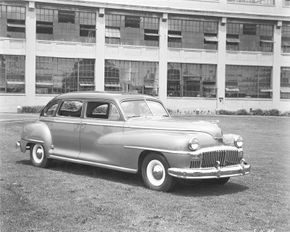
The 1940 model year brought a noticeable upgrade in aesthetics, largely thanks to Dietrich styling. Chrysler stretched the wheelbase to a standard 122.5 inches, with an extended 139.5-inch option available. For the first time, DeSoto offered Fluid Drive, letting drivers stop and start without wrestling with a clutch pedal. The Custom convertible coupe returned to the lineup, though the convertible sedan stayed retired. Sales ticked up by roughly 11,000 units, landing DeSoto at 13th place in the industry rankings. That’s not bad, but it would have been better if a crippling strike at the start of the production year hadn’t crippled their output.
The 1941 Facelift and Record Sales
Volume exploded in 1941. Production jumped from 65,500 to over 97,000 units, shooting DeSoto up to 10th place—its best ever. The secret sauce was a heavy facelift. New cars sat lower, had lower hoods, and sported bolder fronts. The grille featured prominent vertical “teeth” that became a DeSoto hallmark until 1955.
Underneath, standard-chassis models lost an inch of wheelbase but grew 5.5 inches overall. They were lower and wider than the ’40s. A new entrant appeared: the Custom Town Sedan. It was a formal, pretty adaptation of the standard issue with closed rear-roof quarters, priced about $50 higher. DeSoto threw in extras like underseat heaters, pushbutton radios, and streamlined fender skirts to woo buyers.
The 1942 War-Year Redesign
1942 brought an extensive restyle focused on clean lines. DeSoto introduced “Airfoil” hidden headlamps. They were out of sight during the day, appearing only at night. The 1936-37 Cord 810/812 had done something similar, but DeSoto was the only Detroit maker with hidden lamps that year. This gave the front end a surprisingly clean look. To emphasize this, the grille sat entirely on the lower half of the car’s face. A sculpted lady replaced the previous hood mascot.
Mechanically, the model choices held firm, but the six-cylinder engine got a “squarer” treatment. It was bored out to 236.6 cid and detuned to 115 horsepower. This engine would last through the rest of the decade. The war-shortened model year left little time for specials, but DeSoto managed a plush Custom Town Sedan called “Fifth Avenue.” The name would resurface much later at Chrysler.
Identified outside by small nameplates and inside by luxurious leather and Bedford cloth trim, the Fifth Edition cost about $75 more than the regular Town Sedan. Production was low across Detroit in ’42. DeSoto moved fewer than 25,000 units, with some individual models seeing less than 1,000 sales.
The 1946-1948 Transition
DeSoto returned to civilian sales in 1946 with an abbreviated line. The drivetrain and chassis were identical to 1942. The long-wheelbase DeLuxe sedan was gone, leaving only three extended-chassis models, all Customs: a limousine, a seven-seat sedan, and a newcomer called the Suburban.
The Suburban was built for stylish hauling for hotels, airports, and wealthy individuals. A fold-down rear seat without a trunk partition created a massive cargo hold. A metal-and-wood roof rack completed the package. It was the costliest ’46 DeSoto at $2,093—$200 above the seven-seat sedan.
The 1947-48 DeSotos were largely the same as the ’46s. Serial numbers were the only way to tell them apart. They wore a mild facelift of prewar styling: headlamps were reexposed, fenders extended back into the front doors, and the grille became wider and heavier-looking. Medallions and parking lights were reshuffled. Rated horsepower dropped to 109, down six from ’42, though this reflected a new rating method, not mechanical changes.
Beyond civilian cars, DeSoto built 11,600 taxicabs during these years. That made it its fifth best-selling model. Suburban production was also solid, with 7,500 units sold over the period.
The 1949 Redesign
DeSoto got a full redesign for 1949, as did other Chrysler makes. The standard wheelbase grew four inches to 125.5, though the boxy, upright styling hid the increase. This was typical of Chrysler’s new postwar look—dull compared to Ford’s and GM’s offerings.
They kept the vertical-bar grille, similar to the 1942-48 design. The lady mascot was replaced by a bust of Hernando DeSoto. Like any “proper” hood ornament of the time, it glowed when the parking lamps or headlights were on. Horsepower rose by three, to 112. Fluid Drive with “Tip-Toe” semiautomatic shift became standard on Customs and a $121 option for DeLuxes.
For more on defunct American cars, see:
-
AMC
-
Duesenberg
-
Oldsmobile
-
Plymouth
-
Studebaker
-
Tucker
The DeSoto Custom Sportsman and DeSoto FireDome
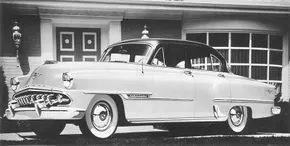
The Mid-Century DeSoto Pivot: From Utility Wagons to Hemis
By 1949, DeSoto was shaking off its post-war stagnation. The new lineup hit showrooms in March, arriving just as the industry was trying to fill the gap left by pre-war constraints. You got two distinct flavors of utility: the $2959 DeSoto woody wagon and the DeSoto Carry-All. The latter was an all-steel beast built on the standard wheelbase. It sat in the DeLuxe line, mimicking the Custom Suburban’s vibe but costing significantly less at $2191.
The actual DeSoto Suburban came back for more, though it got pricier. At $3179, it was over $500 more than the 1948 version. Post-war inflation was hitting everyone, but DeSoto still offered value. You shared the long chassis with the eight-passenger Custom sedan (the limo was axed), gained massive cargo room, and had a roof rack. Throw in the rear jump seats, and you had a genuine nine-passenger hauler.
Did buyers care? Not really. The DeSoto Carry-All moved 2,690 units. The woody wagon? A paltry 850. The Suburban? Just 129. The woody died after 1950, while the Suburban and Carry-All limped along until 1952.
Overall, 1949 was a mediocre year for the brand. Volume flatlined near the 1948 level at roughly 92,500 units, leaving DeSoto dead last in the pack at 12th place. But there was a shift in taste. Customs outsold DeLuxes by a 3-to-1 margin. Buyers wanted luxury, not just transport.
The 1950-1951 Slump and the Korean War Effect
The 1950 model year brought a surprise. Despite only minor tweaks to the rear ends and the introduction of just two new models, production nearly doubled. DeSoto sold nearly 134,000 units, a 45% jump. They debuted the Custom Sportsman, their first hardtop coupe, priced at $2489. Mid-year, they swapped the DeLuxe woody for a cheaper all-steel version, keeping the Custom trim for the woody.
Then came 1951. Styling got a light touch-up. The venerable L-head six was stroked to 250.6 cubic inches. Sure, that added four horsepower, but you barely felt it. The real story was the chrome. DeSoto went heavy on the plating, especially on those aggressive, toothy front grilles. It was perhaps the most chrome-laden Chrysler division at the time.
Sales crashed. Production dropped to 106,000. DeSoto fell to 15th place. Why? Kaiser was launching stunning new designs. Hudson was throwing its powerful new six-cylinder Hornets into the ring. And then there was the Korean War. The government ordered production cutbacks, squeezing the automakers from above.
Enter the FireDome: DeSoto’s First V-8
1952 changed everything. DeSoto introduced its first-ever V-8. They called it FireDome. It wasn’t just a new engine; it was an overhead-valve hemi-head design. Specifically, it was a smaller, 276.1-cid derivative of the brilliant 331-ci Chrysler V-8 introduced the year before. It made 160 horsepower.
This put DeSoto firmly in the Detroit horsepower race. It wasn’t about speed alone; it was about signaling that the brand had arrived in the muscle car era. The FireDome powered a new top-of-the-line series that shared everything with the Custom line except the Suburban.
The engine sold itself. The FireDome series alone moved nearly 50,000 units. But the brand as a whole stalled at 88,000 units. Still, it was enough to climb back to 13th in the production rankings.
Virgil Exner Takes the Wheel
By 1953, the landscape shifted again. DeSoto merged the remaining Custom and DeLuxe models into a new Powermaster Six series. It lagged behind the FireDome V-8 models by a 2-to-1 margin. Both lines offered the Sportsman hardtop.
But the real story was Virgil Exner. The newly recruited styling chief was leaving his mark. The 1953 DeSoto kept the massive 1952 bulk but added Exner’s signature flair. New one-piece windshields. Liberal chrome accents. It was a more sophisticated look.
Volume jumped back to 130,000 units. DeSoto moved up to 11th place. It was their best finish since the banner year of 1941. The brand was finding its footing again, riding the wave of Exner’s forward-looking design and the FireDome’s raw power.
The Adventurer Legacy and the ‘Forward Look’
DeSoto needed a personality transplant in 1954. The brand was stiff. Dour. The solution arrived in the form of the DeSoto Adventurer I, a show car that injected serious zest into a lineup that had lost its way. It was part of a broader strategy by stylist Virgil Exner to shake up Chrysler Corporation’s image, starting with the Plymouth XX-500 in 1950. Most of these concept machines were built by Ghia in Italy, and the Adventurer I was no exception.
It sat on a shortened 111-inch wheelbase. The body was an off-white, close-coupled coupe featuring outside exhaust pipes, wire wheels, and a cockpit full of instruments. It was aggressive. It was Italian. It was exactly what the brand needed to look at.
“Had it been mass-produced… it would have been the first four-passenger sports car made in this country.”
Exner later claimed that if the Adventurer I had made it to the assembly line, it would have been the first true four-passenger sports car in America. Not a 2+2. A real four-seater. And it had the DeSoto Hemi. He called it his favorite.
The Adventurer II arrived in 1955, but it was a different beast. Built on a standard chassis, it was a four-seat fastback. Ghia’s hand was more visible here than Exner’s. Painted deep red and stripped of bumpers, it was sleek. It lacked the integrated cohesion of its predecessor. It wasn’t seriously considered for production.
The 1955 Forward Look
While the show cars dazzled, the factory had to deal with reality. The 1954 DeSotos were essentially the 1949 bodyshell given a modest facelift. It was a stopgap. The V-8 received a tweak to 170 horsepower, but the real headline was the mid-year introduction of the two-speed PowerFlite. This was Chrysler’s first fully automatic transmission. It would become standard on many DeSotos for the next six years.
Meanwhile, the old Fluid Drive was fading. Overdrive ($96 extra) was becoming obsolete. Long sedans were losing ground. The Powermaster Six engine was on its way out. The sales numbers reflected the chaos. DeSoto’s output dropped below 77,000 units. The brand fell to 12th place in the industry. A bad year for everyone in Detroit, but particularly painful for a marque trying to reinvent itself.
Then came 1955.
Virgil Exner’s new “Forward Look” styling hit the streets with bold, fully updated designs. The old Firedome line was demoted. The “d” was no longer capitalized. It played second banana to the new, uplevel Fireflite series. Both lines shared a 126-inch wheelbase with the 1955 Chryslers. The heart of the operation was the Hemi engine, bored out to 291 cubic inches.
Power ratings reflected the hierarchy. Firedomes made 185 horsepower. Fireflites pushed 200.
No Chrysler product in 1955 was boring, but DeSoto looked the busiest. And the most attractive. The silhouette was lower. The windshield was wrapped. It sported the last of the “toothy” grilles—the iconic vertical bars that defined the early Forward Look era. The dashboard featured the famous “gullwing” design. Two-tone paint was optional but heavily pushed.
The market responded. Division output surged to nearly 115,000 units. It was still only good for 13th place, but it was a massive improvement. Detroit was selling cars like hotcakes, and DeSoto finally had a product that matched the zeitgeist.
Models, Paint, and Performance
The Firedome offered the only DeSoto wagon for 1955. Inside the lineup, the Special hardtop was priced about $110 below the Sportsman counterpart. Then there was the Coronado sedan. Added mid-1954 to the Firedome range, it returned in 1955 as a “spring special” Fireflite. It cost $100 more than the regular sedan, which started at $2,800.
Today, the 1955 Fireflite is a minor collector’s item. Why? Because it wore one of the industry’s first three-tone paint jobs: turquoise, black, and white. It was flashy. It was expensive. It was memorable.
Convertibles existed in both series but sold in minuscule numbers. Just 625 Firedomes. 775 Fireflites. Not enough to save the style from obscurity, but enough to create a niche.
By 1956, the displacement grew. A longer stroke pushed the DeSoto Hemi to 330.4 cubic inches. Firedome horsepower jumped to 230. Fireflites hit 255. The grille teeth were replaced by wire mesh. The instruments turned unreadable, featuring gold characters on white backgrounds.
The biggest change, however, was the tailfins. They were modest for 1956, but they were there. DeSoto’s fins featured distinctive “tri-tower” taillamps. Stacked pairs of round red lenses separated by a matching backup lamp. This design language would persist through 1959, becoming a hallmark of the brand’s final era.
DeSoto followed GM’s lead in hardtop design. For 1956, they introduced three four-door hardtops: a Sportsman in each series and a low-priced Firedome Seville. The Seville hardtop coupe replaced the previous Firedome Special. Note: Cadillac also introduced a two-door hardtop called the Eldorado Seville that same year. No legal battles ensued. The name was shared.
Mid-season brought a highlight. The limited-edition Adventurer hardtop coupe. It was a supercar awash in gold-anodized aluminum trim. Under the hood sat a new 341-cubic-inch Hemi making 320 horsepower. It joined the Highland Park performance squadron, alongside the Chrysler 300B, Plymouth Fury, and Dodge D-500. These were the muscle cars before the term existed.
DeSoto was selected as the official pace car for the 1956 Indianapolis 500. The division celebrated by building about 400 “Pacesetter” replicas. They were all Fireflite convertibles with Adventurer-style trim. Price? $3,615 apiece. A steep ask. A desirable machine.
For more on defunct American cars:
– AMC
– Duesenberg
– Oldsmobile
– Plymouth
– Studebaker
– Tucker
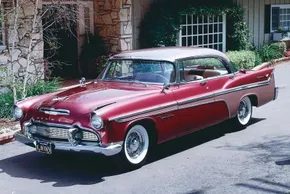
Sales volume dropped by roughly 4,300 units as the entire industry shrank in 1956, but DeSoto climbed back to 11th place in the rankings. It wasn’t because DeSoto was booming. It was because Nash, Hudson, Studebaker, and Packard were bleeding out. DeSoto held that 11th spot again in 1957, even as production jumped to approximately 110,500 vehicles. They were within 7,200 units of surpassing parent brand Chrysler. For a brief moment, the division had legs.
The 1957 models were all-new for the second time in three years. The engineering was sharp. The styling was arresting.
To capture more market share, DeSoto introduced the Firesweep series. It was built on the 122-inch Dodge platform, effectively lowering the entry price. The Firesweep sedan started at just $2,777. The cheapest Firedome cost $2,958. Firesweeps came in two-door and four-door hardtop versions, plus six-seat Shopper wagons and nine-passenger Explorer wagons. Fireflites added convertibles to that mix. Firedomes matched Fireflites but dropped the wagon option entirely.
They were heavy. They were big. They were fast.
The upper-series Firedomes and Fireflites used the 341 cubic-inch V-8 from the 1956 Adventurer. Outputs were 270 horsepower for the Firedome and 295 for the Fireflite. Firesweeps ran the previous year’s 330, bored out to 325 cubic inches. Standard output was 245 horsepower. You could pay more for 260.
Above Fireflite sat the Adventurer. It arrived as a hardtop coupe and later a soft-top convertible. Its 345 cubic-inch Hemi produced 345 bhp. Simple, elegant, powerful.
Virgil Exner’s “Forward Look” styling defined this era. The second-generation version was particularly handsome on DeSoto. The profile was dartlike. Tri-tower taillamps were integrated into soaring rear fenders. Side moldings were simple but effective. The grille and bumper were prominent. Glass area was massive.
Corporate-wide adoption of torsion-bar front suspension helped. These heavy cars handled uncannily well. Performance was aided by the new TorqueFlite automatic transmission. It was quick, responsive, and optional. It replaced the older PowerFlite. Controlled by pushbuttons at Highland Park, the TorqueFlite would outlive the DeSoto brand itself.
Despite the excitement, trouble loomed. Dodge was moving upmarket. Chrysler was moving down. The overlap was fatal.
Production plunged in 1958. Just 50,000 units rolled off the line. That was the lowest total since 1938. A sharp national recession hit. Workmanship had suffered after the frantic push of 1956. Marketing decisions were poor. The downward spiral was irreversible.
The 1958 DeSotos looked mostly like the 1957s. Grilles were busier. Trim was different. Standard equipment shifted to quad headlights. States hadn’t approved “quadrilights” in ’57, so front fenders were designed to take one or two lamps depending on local law. By 1958, four-lamp systems were legal nationwide.
The lineup returned with a new Firesweep convertible. The ’58 Adventurer ragtop cost $4,369. It was the most expensive DeSoto ever, though Chrysler’s convertible 300D cost nearly $1,300 more.
Engine displacement grew. Power ratings climbed. But the Hemi was expensive to build. Chrysler began switching to cheaper wedgehead V-8s for 1958.
Two new “Turboflash” DeSoto engines entered the fray. Firesweeps got a 350-cubic-inch mill. 280 horsepower standard. 295 with an optional four-barrel carburetor. Firedomes and Fireflites carried a 361-cubic-inch big-bore engine. 295 bhp in standard Firedome tune. 305 bhp with twin four-barrels in Fireflites. That setup was optional on Firedomes too. Adventurers kept the high-compression 345. A special 355-cubic-inch version was available for Adventurers with optional Bendix fuel injection.
The injection kit cost $637.20. Few people bought it. The system was fraught with problems. Most were probably swapped back to carburetors. Even without the Hemi or injection, the 1958 DeSotos were quick. The TorqueFlite was now standard on Fireflites and Adventurers. Firesweeps kept the three-speed manual. Firedomes offered the PowerFlite as an extra-cost option.
A 305-horsepower Firedome could hit 0-60 mph in 7.7 seconds. 0-80 in 13.5 seconds. Top speed was 115 mph.
DeSoto claimed those towering tailfins added stability at speed. That was propaganda. The fins did almost nothing aerodynamically under 80 mph. Their only real purpose was to make Chrysler products stand out. They succeeded. They stood out.
Then they stopped.
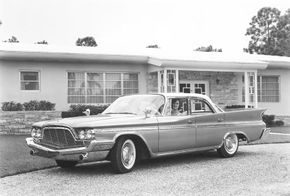
The Slow Death of a Brand
By 1959, the writing was on the wall for DeSoto, even if the company refused to read it. The lineup looked familiar, but the bones had changed. The Firesweep got a 361 cubic-inch wedge engine, but it was a single, weak 295-horsepower spec. Meanwhile, the Firedome, Fireflite, and Adventurer moved up to a massive 383. Horsepower varied by trim: 305 for the Firedome, 325 for the Fireflite, and 350 for the top-tier Adventurer. Sales ticked up slightly for the Adventurer, but total production sat at a meager 46,000. That number didn’t sustain a brand.
Rumors of DeSoto’s demise started circulating in ’59, and naturally, buyers hesitated. Calendar-year output edged up from 1958, but it was still less than half the 119,000 units sold in 1957. The recession hit DeSoto hard, same as Oldsmobile, Buick, and Mercury. But those brands had higher sales floors to fall from. And unlike them, DeSoto had no compact plan for 1960-61. Their 1962 strategy included smaller standard cars, but no entry-level model.
The real killer wasn’t the economy. It was corporate strategy. Chrysler had reorganized its dealer networks. You got Chrysler-Plymouth, DeSoto-Plymouth, and Dodge-Plymouth. When Imperial launched as a standalone luxury brand in 1955, Chrysler Division expanded downward into lower prices, while Dodge moved upward with larger, more luxurious vehicles. DeSoto was squeezed out. Nowhere to go but to die.
The Denial Game
Chrysler initially denied the rumors. They even staged a party for the two-millionth DeSoto rolled off the line in 1959. Press releases boasted that nearly a million DeSotos were still on the road. They claimed $25 million was earmarked for future models, with $7 million for 1960 alone. Officials promised commitments for 1961 and work on 1962-63 models. They pointed out that DeSoto had consistently been profitable.
Then, in 1960, Chrysler merged DeSoto and Plymouth divisions. The new compact Valiant was launched, ostensibly as a separate make. Valiant sold well. Plymouth did okay. DeSoto tanked. In the first two months of 1960, DeSoto moved just 4,746 units. That was 0.51% of the industry share, down from 6,134 units (0.72%) in the same period the previous year.
The 1960 Holdover
The 1960 DeSoto line was a shadow of its former self. Just a sedan, hardtop sedan, and hardtop coupe in two series. The upper trim was still called Adventurer, but it cost a few hundred dollars less than the ’59 Fireflite. It was also far less special. Fireflite was now the base model, sitting in the $3,000 range. The most popular model was the Fireflite sedan, but it only sold 10,000 units.
All 1960 DeSotos shared the 122-inch wheelbase with the Chrysler Windsor and Dodge Matador/Polara. They adopted corporate-wide “unibody” construction, except for Imperial. Adventurers used the 305-hp 383 from the discontinued Firedome. Fireflites got the 295-hp 361 from the old Firesweep.
Styling was virtually identical to the 1960 Chrysler. A blunt, trapezoidal grille with small horizontal bars sat atop a huge V-shaped bumper with rubber-capped guards. Fins were as high as ever. Performance was down. An Adventurer could keep up with a Windsor off the line, but it lost to a Chrysler Saratoga or a lighter Dodge Dart Phoenix with a 383.
The Token Final Year
DeSoto’s appearance for 1961 was brief. Production was low: just 3,034 units. There was one nameless series. Four-door pillared sedans were gone. Minimal advertising focused on styling. “Odd” was the better word. The front end featured diagonally stacked quad headlights flanking a weird “double” grille with a latticelike lower section. Above it sat a large oval holding the DeSoto name in unreadable stylized letters against a fine mesh. The rest was uninspired.
DeSoto’s fate was sealed. Chrysler wound down production by Christmas 1960, filling remaining orders with ’61 Windsors instead. Some DeSoto-Plymouth dealers became Chrysler-Plymouth stores, angering nearby Chrysler-Plymouth dealers. Left unborn were the smaller 1962 DeSotos planned on the new corporate “S-series” platform. Not a huge loss; those dumpy cars would have struggled anyway.
It was a sad end for a marque that had driven business for Chrysler for over three decades. Ironicaly, it was premature. Less than a year later, DeSoto was resurrected at Dodge. It bolstered sales of the unpopular 1962 standard line, which had been shrunk to near-compact size. Called the Custom 880, this reborn full-size Dodge was similar to the ’61 DeSoto and cost about the same. But it sold better with smoother styling and more choices.
DeSoto’s rapid decline, like Edsel’s, stemmed from a “loser” image as much as a changed market.