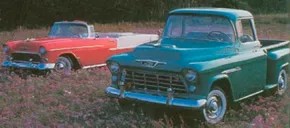
Chevrolet didn’t mess around in 1955. The brand shipped out 75 distinct “Task-Force” trucks across 15 different wheelbases. That roster covered everything from nimble light delivery haulers to heavy-duty over-the-road workhorses. But the real story, the one that defined the era, was the light-duty segment. We are talking about the lines rated up to one ton. Pickups were everywhere in the catalog, each with a specific job in mind.
The Pickup Hierarchy
The ½-ton models lived in the 3100 series. Standard wheelbase sat at 114 inches. If you needed the Cameo Carrier, it shared that same footprint. Then there was the oddball 3200 series. Only one model existed. It was a ½-ton long-bed pickup. It borrowed its 123.25-inch wheelbase and heavier frame side rails from the ¾-ton 3600 line. Simple engineering, shared parts, different label.
The big dog was the 3800-series pickup. Rated for one ton, it rolled on a massive 135-inch wheelbase. New rear fender styles appeared across the board, except for the Cameo Carrier. These fenders cant forward. A cap with a crease line topped them, mimicking the sculpting on the cab sides. Pricing started at $1,519 for a basic fender-side 3100. Jump to the beefier 3800 and the base price hit $1,844.
Body Configurations and The Suburban
Variations were the name of the game. Both the 3100 and 3800 series offered panel trucks. Stake-beds and platforms came in ¾-ton or one-ton ratings. If you needed a blank canvas for aftermarket specialty bodies, Chevrolet sold chassis-and-cab, chassis-and-cowl, and chassis-and-windshield units. These were available in the 3100, 3600, and 3800 series.
The 3100 series had an exclusive: the Suburban Carryall. It was a two-door station wagon based on the ½-ton panel body. Buyers could choose twin side-hinged panel doors or a two-piece tailgate. With the middle and rear seats up, the Suburban fit eight people. The bodyside crease that ran down the pickup cab stretched the full length of the new Suburban and panel truck bodies. It was a continuous visual line that tied the utility vehicles together.
Chassis and Suspension Overhaul
Chevrolet totally changed chassis frames when moving from the First to the Second Series trucks. The old frame tapered. It was 26 inches wide at the front and widened to 46 inches between the rails in the rear. The 1955 frame ditched that taper. The siderails were perfectly parallel in plan view. 34 inches across at both ends. Straight rails.
Solid axles remained fore and aft. Longitudinal leaf springs and tubular shocks handled all four corners. Rear tube shocks became optional on the 3800s. The I-beam front axle got widened and lowered for 1955. Meanwhile, the front springs lengthened in each light-duty series. The rear springs now attached to special outboard brackets. The six-cylinder engine switched to a four-point mounting system, replacing the previous three-point setup.
Engine Choices and the V-8 Growing Pains
Buyers had two main paths for power. The traditional 235.5-cubic inch inline “Stovebolt” six. Or the brand new 265-cubic inch V-8. The V-8 was still so new that skeptics waited. They wanted to see if Chevrolet could work out the bugs. Those bugs existed. Early Chevrolet V-8s had a significant flaw: piston rings were slow to seat. The engines burned oil. Mechanics found a fix. Pour a little Bon Ami in water down the carburetor. It sped up the break-in process and solved the oil-consumption problem.
“The V-8 was still so new that some people wanted to wait until Chevrolet worked out the bugs.”
The Second Series six produced 123 horsepower at 3,800 rpm. Torque hit 207 pound-feet at 2,000 rpm. The optional Trade-master V-8 was a detuned version of the hot new passenger-car engine. It made 145 horsepower at 4,000 rpm. Peak torque of 238 pound-feet arrived at 2,000 revs. A one-barrel carburetor fed the six. A twin-throat unit served the V-8. Both engines ran a 7.5:1 compression ratio.
The 1955 Task-Force lineup wasn’t just about horsepower figures or wheelbases. It was a complete mechanical reinvention. Parallel frames. New suspension geometry. A V-8 that needed some tuning. You bought one of these trucks knowing you were part of a transition. The old tapered frames were gone. The new V-8s were raw. And the options list stretched as far as your budget and imagination allowed. What happens next depends on which engine you chose and how hard you pushed those new parallel rails.