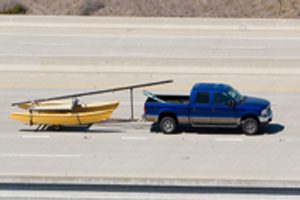
Knowing your tow rating isn’t just about not snapping a hitch pin. It is the hard limit set by engineers who know exactly where your frame begins to twist and your transmission starts to cook. Ignore it, and you are gambling with your drivetrain. The number is in your manual. Always trust the manufacturer over the sticker on a third-party hitch because those hitches are rated for a range of vehicles, not just the one sitting in your driveway.
When you look up your numbers, remember that “maximum” is a theoretical ceiling. It assumes a perfectly loaded car with no passengers, no cargo, and no options. If you have a full tank of gas and three people in the back, you have to subtract that weight. Passenger weight over 150 lbs, optional equipment, and extra gear all eat into your towing capacity. Exceed the limit, and you aren’t just voiding your warranty. Your handling degrades. Your stopping distance stretches. The drivetrain takes a beating it wasn’t designed for.
Here is what the charts say for 2006 through 2009 models from the luxury and mainstream brands listed below.
Acura Towing Capacity
Acura’s lineup in this era was small. You were mostly looking at the MDX if you had any serious hauling ambitions. The sedans were light sporty toys, not workhorses.
| Year | Model | Max Towing Capacity (lbs) |
|---|---|---|
| 2006 | MDX | 3500 |
| 2006 | RL | 1000 |
| 2006 | RSX | 1500 |
| 2006 | TL | 1000 |
| 2006 | TSX | – |
| 2007 | MDX | 5000 |
| 2007 | RL | 1000 |
| 2007 | RDX | 1500 |
| 2007 | TL | 1000 |
| 2007 | TSX | 1000 |
| 2008 | MDX | 5000 |
| 2008 | RL | 1000 |
| 2008 | RSX | 1500 |
| 2008 | TL | 1000 |
| 2008 | TSX | 1000 |
| 2009 | MDX | 5000 |
| 2009 | RL | 1000 |
| 2009 | RSX | 1500 |
| 2009 | TSX | 1000 |
The jump in the 2007 MDX from 3500 to 5000 lbs is massive. That is a significant engineering update.
Related specs to check if you are modifying a truck or SUV: GVWR, GAWR, GCWR, Cargo Carrying Capacity, Curb Weight, and Payload.
Audi Towing Capacity
Audi was conservative here. Unless you had the Q7, you were pretty much out of luck for anything heavier than a bicycle rack. The performance models like the TT and R8 were strictly for track days, not trailers.
| Year | Model | Max Towing Capacity (lbs) |
|---|---|---|
| 2006 | A3 | – |
| 2006 | A4 | – |
| 2006 | A6 | – |
| 2006 | A8 | – |
| 2006 | S4 | – |
| 2006 | TT | – |
| 2007 | A3 | – |
| 2007 | A4 | – |
| 2007 | A6 | – |
| 2007 | A8 | – |
| 2007 | Q7 | 5500 |
| 2007 | RS4 | – |
| 2007 | S4 | – |
| 2007 | S6 | – |
| 2007 | S8 | – |
| 2008 | A3 | – |
| 2008 | A4 | – |
| 2008 | A5 | – |
| 2008 | A6 | – |
| 2008 | A8 | – |
| 2008 | Q7 | 5500 |
| 2008 | R8 | – |
| 2008 | RS4 | – |
| 2008 | S4 | – |
| 2008 | S5 | – |
| 2008 | S6 | – |
| 2008 | S8 | – |
| 2008 | TT | – |
| 2009 | A3 | – |
| 2009 | A4 | – |
| 2009 | A5 | – |
| 2009 | A8 | – |
| 2009 | Q7 | 5500 |
| 2009 | R8 | – |
| 2009 | S4 | – |
| 2009 | S5 | – |
| 2009 | S8 | – |
| 2009 | TT | – |
Related specs to check if you are modifying a truck or SUV: GVWR, GAWR, GCWR, Cargo Carrying Capacity, Curb Weight, and Payload.
BMW Towing Capacity
BMW drew a hard line. Sedans and coupes? Zero towing capacity. Period. The SUVs were the only workhorses. The X5 and X6 held the line at 6000 lbs, which is respectable for a vehicle built on a sporty chassis. The X3 was limited to 3500 lbs.
| Year | Model | Max Towing Capacity (lbs) |
|---|---|---|
| 2006 | 325 | – |
| 2006 | 330 | – |
| 2006 | 525 | – |
| 2006 | 530 | – |
The numbers don’t lie. If you are pulling a trailer in the mid-2000s, your capacity is a hard limit. Not a suggestion.
Look at the Chevy Avalanche 1500 in 2006. It clears 7,300 lbs. Two years later, in 2009, that same badge drops to 5,000 lbs. Why? Engineering changes, weight creep, or just the reality that older platforms get tired. You need to know exactly what your rig can handle before you hook up.
One wrong calculation and you’re sliding sideways on I-95 with 4,000 lbs of luggage behind you.
Here is the breakdown. No fluff. Just the limits.
Chevrolet Limits
Chevy played in two arenas: the light-duty trucks that tried to be SUVs and the heavy haulers that actually meant business.
In 2006, the Silverado 1500 Hybrid was the quiet giant. It pulled 6,700 lbs. The SS version? 7,500. The heavy-duty Silverado 2500 HD was the king of the hill at 10,100 lbs. If you had the 3500 HD, you were looking at 9,500 lbs. Yes, the 3500 pulled less than the 2500 in this year. Configuration matters. Axle ratios, cab styles, and engine options shifted those numbers daily.
By 2008, Chevy added the Tahoe Hybrid. It sat at 6,200 lbs. Solid. Better than the gas-only Tahoe at 4,500 lbs. The Suburban 2500 climbed to 9,600 lbs. That’s van territory.
Don’t sleep on the Colorado. It started at 1,600 lbs in 2006. By 2008, it jumped to 3,000 lbs. Small truck, big leap.
The Corvette never towed. Not one lb. Don’t try it.
2006 Chevy Highlights:
– Avalanche 2500: 10,200 lbs
– Silverado 1500 SS: 7,500 lbs
– Tahoe: 5,700 lbs
2009 Chevy Changes:
– Avalanche 1500 dropped to 5,000 lbs.
– Express 2500 hit 6,300 lbs.
– Traverse entered at 2,000 lbs.
If you need payload data, check the GVWR and GCWR charts. Towing capacity assumes you have the payload to spare. You rarely do.
Chrysler and Dodge Numbers
Chrysler and Dodge shared parts bins. You saw it in the trim. You saw it in the towing.
The PT Cruiser was quirky but capable. In 2006, it towed 3,500 lbs. By 2008, it dropped to 2,600 lbs. Why? Maybe emissions hardware added weight. Maybe they realized people were stripping the rear seats to make room for gear and decided to cut the rope.
The Pacifica minivan started at 1,000 lbs in 2006. Then it nearly tripled to 2,600 lbs in 2007. Then it settled at 1,000 lbs again in 2008. Inconsistent? Or just different wheelbase configurations? The numbers swing wildly. Verify your VIN.
Dodge’s Ram 3500 was a beast. 10,500 lbs in 2006. 12,300 lbs by 2009. That’s a massive jump. The Durango stayed consistent around 3,750-3,850 lbs. The Durango Hybrid in 2009 added 5,750 lbs. Hybrid torque helps here.
The Sprinter Van was the unsung hero. 2500 model pulled 5,000 lbs. The 3500 model hit 7,500 lbs by 2007. Industrial workhorse. Not pretty. But it worked.
Chrysler Specifics:
– 2006 Town & Country: 1,700 lbs.
– 2008 Town & Country: 3,600 lbs.
– Aspen: 8,950 lbs (gas only). Hybrid version in 2009? 6,000 lbs.
Dodge Specifics:
– Ram 1500 started at 2,900 lbs. By 2009, it hit 3,800 lbs.
– Grand Caravan: 3,700 lbs (2006) down to 3,600 lbs (2009).
– Viper? Zero. It’s a supercar. It doesn’t tow. It escapes.
Ford’s Heavy Lifting
Ford stuck to the traditionalists. F-Series trucks did the heavy lifting.
The F-350 was the anchor. 8,600 lbs in 2006. 10,700 lbs in 2008. Then the F-450 appeared. 16,000 lbs. That’s commercial grade. You’re not towing a boat with that. You’re towing a construction site.
The F-150 climbed steadily. 6,400 lbs in 2006. 6,500 in 2007. 6,500 in 2008. Then 8,700 in 2009. That’s a 35% increase in three years. Aluminum body? No, that came later. Likely frame stiffening and engine tuning.
SUVs were weaker. The Explorer sat at 3,110 lbs in 2006. 3,500 lbs thereafter. The Expedition was the real hauler. 9,200 lbs. Consistent. Reliable. Boring? Maybe. Effective? Absolutely.
The Escape Hybrid pulled 1,000 lbs. Don’t let the hybrid tech fool you. It’s for light loads. Bike racks. Small campers. Not a travel trailer.
Ford 2009 Shifts:
– F-150 jumped to 8,700 lbs.
– E-Series vans held steady at 6,000-7,400 lbs depending on model.
– Flex and Taurus X capped at 2,000 lbs. Crossovers were not built for towing then.
The Reality Check
You see the numbers. They look safe. They aren’t.
Towing capacity is the max. You are driving with it. Rain. Headwinds. Brake fade. Tire blowouts.
Every model listed here has a specific payload capacity. If your truck weighs 5,000 lbs and your payload limit is 1,500 lbs, you’re full with four people and a gas can. You have zero room for tongue weight. Tongue weight eats 10-15% of the trailer load.
If you tow a 5,000 lb trailer, that’s 500-750 lbs on the hitch. Subtract that from your payload. You might only have 200 lbs left for passengers.
Check the door jamb sticker. Not the brochure. The sticker.
Specs change by engine. By axle ratio. By cab style. A Silverado with a short bed and 3.42 gears pulls differently than one with a long bed and 4.10 gears.
These numbers are baselines. Your safety depends on knowing what’s actually on your axle.
GMC heavy haulers and hybrid updates
GMC’s lineup in these years tells a story of steady refinement, with the Sierra 2500 consistently punching above its weight class. If you are looking at the 2009 GMC Sierra 2500 towing capacity, you are looking at 10,500 lbs. That is the peak for the heavy-duty half-ton equivalent in that era. The Sierra 3500 dips slightly to 10,100 lbs in 2009, after holding at 10,000 lbs in 2006. It is a weird quirk of engineering where the heavier chassis sometimes yields less max tow due to curb weight penalties or brake capacity limits.
The Sierra 1500 saw a jump from 4,000 lbs in 2006 to 4,800 lbs by 2007. It stayed flat through 2009. That is a solid 20 percent gain right out of the gate. If you need to pull a small trailer, the Canyon is your budget option. It started at 1,800 lbs in 2006 and crept up to 2,400 lbs by 2009. Not much, but every pound counts when you are hauling a jet ski.
The Yukon line is where the luxury meets utility. The standard Yukon dropped from 5,700 lbs in 2006 to 4,500 lbs in 2007, then climbed back to 4,800 lbs in 2009. The XL version is the real workhorse here. It maxed out at 7,500 lbs in 2006, dipped to 7,100 lbs in 2008, then hit a low of 5,100 lbs in 2009. Wait. Did the 2009 Yukon XL lose over 2,000 lbs of towing capacity? Yes. It is likely due to a shift in platform dynamics or the introduction of hybrid options affecting payload distribution. The Yukon Hybrid, introduced in 2008, holds steady at 6,200 lbs.
The Envoy stayed static at 5,300 lbs for its entire run. The Acadia entered in 2007 with a modest 2,000 lbs limit. It did not increase in 2008 or 2009. If you are towing anything heavier than a small boat, the Acadia is not the tool for the job. The Savana vans are utilitarian beasts. The 2500 model handles 6,300 lbs across all years. The 3500 drops to 6,200 lbs in later years, likely due to increased curb weight from larger bodies or brake updates.
Honda reliability and modest limits
Honda’s towing numbers are conservative. They prioritize longevity over brute force. If you are checking the 2006 Honda Ridgeline towing capacity, you are looking at 5,000 lbs. That was the top of their lineup in 2006. By 2007, the Ridgeline’s listed capacity disappears in many databases, though the platform remained. It reappears in 2008 with that same 5,000 lb limit.
The Pilot is a popular family hauler. It starts at 3,500 lbs in 2006 and 2008. In 2007, the number vanishes, then returns in 2009 at 3,500 lbs. The Odyssey also holds steady at 3,500 lbs from 2006 through 2009. It is one of the few minivans that can genuinely tow a medium-sized trailer.
Compact cars and small SUVs are not built for heavy loads. The Civic tops out at 1,500 lbs in 2006 and 2008. In 2009, it drops to 1,000 lbs. The Accord is even more limited, listed at just 1,000 lbs in 2006 and 2007, then disappears from towing charts entirely in 2008 and 2009. The CR-V has no towing capacity listed for any year in this window. Do not try to tow with a second-generation CR-V. The Element stays at 1,500 lbs for 2006 and 2008, but like the Pilot, it has a gap in 2007.
The Fit enters in 2007 with no towing capacity listed. The Rondo appears in 2007 but also shows no towing data. It seems Honda simply did not certify these smaller platforms for towing during this specific cycle.
Hummer size and steel
Hummer’s towing numbers reflect their intended use: off-road capability and sheer mass. The H2 is the big dog here. In 2006, it tows 6,500 lbs. 2007 bumps it to 6,600 lbs. By 2008 and 2009, the H2 hits 8,200 lbs. That is a significant increase. It likely stems from chassis reinforcements or updated transmission cooling.
The H3 is the smaller brother. It holds a steady 3,000 lbs across all years from 2006 to 2009. The H3T, which is the pickup version, adds a bit more utility, hitting 4,400 lbs in 2009. The H1 Alpha in 2006 is a outlier, capable of 7,887 lbs. It is a military-derived vehicle. Its towing capacity is impressive for its age, but its fuel economy is a different story.
Hyundai value and practicality
Hyundai’s lineup in this era was still establishing its reputation for durability. The Santa Fe is the primary tow vehicle. It starts strong at 2,700 lbs in 2006. By 2007, it drops to 1,650 lbs and stays there through 2008. This drop might be due to different trim levels or engine availability in different markets. The Tucson is consistently limited to 1,000 lbs. The Elantra starts at 1,500 lbs in 2006, then drops to 750 lbs in 2007 and 2008.
The Azera and Sonata are sedans. They are capped at 1,000 lbs. The Tiburon and Accent have no towing capacity listed. The Veracruz also shows no towing data. The Entourage, Hyundai’s minivan, holds at 1,000 lbs in 2007 and 2008. The Genesis appears in 2009 with no towing capacity listed. Hyundai was not pushing heavy towing in their passenger cars during this period.
Infiniti luxury and SUV strength
Infiniti relies on the QX56 for heavy towing. In 2006 and 2007, the QX56 can handle 9,000 lbs. In 2008, the number disappears, but it returns in 2009 at 9,000 lbs. It is one of the few luxury SUVs in this list that can tow a horse trailer or a large travel trailer.
The FX series is the sporty crossover. The FX35 and FX45 both max out at 3,500 lbs in 2006, 2007, and 2008. In 2009, the FX35 disappears, but the FX50 appears with that same 3,500 lb limit. The G and M sedans are strictly limited to 1,000 lbs. They are not built for towing. The EX35 has no towing capacity listed in 2008.
Isuzu and Jaguar conservatism
Isuzu’s numbers are modest. The Ascender holds steady at 5,300 lbs across 2006, 2007, and 2008. The i-series trucks are smaller. The i-280 tows 1,700 lbs in 2006, rising to 2,100 lbs in 2007 and 2,200 lbs in 2008. The i-350 and i-370 are the heavy hitters. They start at 4,000 lbs in 2006 and 2007, then jump to 5,500 lbs in 2008. It is a clear upgrade in chassis strength or cooling capacity.
Jaguar’s lineup during these years shows no towing capacity for any model. The S-Type, X-Type
Lexus Heavy Haulers and the Luxury Divide
If you are looking at a mid-2000s Lexus, your towing options are split by two distinct lines. The luxury sedans and coupes generally refuse to pull anything. The trucks and SUVs, however, are built for the job.
Let’s look at the Lexus towing capacity data for 2006 through 2009.
In 2006, the lineup is sparse. The ES 330, GS 300, GS 430, IS 250, IS 350, and SC 430 all show a dash. Zero pounds. Do not try to tow with these. The LS 430 has a rating of 2000 lbs, but that is barely enough for a small jet ski.
The heavy lifters are the off-roaders. The GX 470 and LX 470 both max out at 6500 lbs. That is serious power for a luxury badge. If you need to move a boat or a large camper, the RX 330 and RX 400h offer 3500 lbs. That is decent for a small trailer.
By 2007, the LS 460 appears, and it drops towing completely. The GS 350, GS 430, GS 450h, IS 250, IS 350, and SC 430 remain non-tow capable. The GX 470 and LX 470 hold steady at 6500 lbs. The RX 350 and RX 400h stay at 3500 lbs.
2008 brings a major shift. The LX 570 debuts with a massive 8500 lbs rating. That is a heavy-duty number. It dwarfs the previous LX 470 capacity. Meanwhile, the RX 350 and RX 400h drop significantly. They fall from 3500 lbs to just 2000 lbs. Why the drop? Lexus likely tightened safety margins or adjusted suspension components. If you own a 2008 RX, do not assume it can tow what a 2007 model could.
The IS-F appears in 2008 and 2009. Zero towing. It is a V8 sports car, not a hauler. The LS 460 and LS 600h still cannot tow anything.
Lincoln’s Truck Strategy and Sedan Limits
Lincoln takes a different approach. The sedans are weak, but the trucks are robust.
In 2006, the Lincoln LS, Town Car, and Zephyr have no towing rating. The Mark LT is the king of the year with 8900 lbs. The Navigator sits at 6000 lbs. The Town Car holds 2000 lbs.
2007 sees the MKX enter with 2000 lbs. The MKZ has no rating. The Mark LT remains at 8900 lbs. The Navigator stays at 6000 lbs. The Town Car stays at 2000 lbs.
2008 is nearly identical. MKX at 2000 lbs. MKZ at zero. Mark LT at 8900 lbs. Navigator at 6000 lbs. Town Car at 2000 lbs.
2009 adds the MKS, which can tow 1000 lbs. That is very low for a full-size sedan. The MKX remains at 2000 lbs. The MKZ still cannot tow. The Navigator holds 6000 lbs. The Town Car holds 2000 lbs.
If you need to tow a large trailer, the Mark LT is the only real option here. 8900 lbs is significant. The Navigator is reliable at 6000 lbs. Everything else is for light luggage, not heavy loads.
Mazda’s Utility Vehicles and Tractor Limits
Mazda’s data reveals a strange mix of small cars and surprisingly capable compact trucks.
In 2006, the B2300 can tow 1600 lbs. The B3000 pulls 2500 lbs. The B4000 is the workhorse at 3140 lbs. The MPV minivan handles 2000 lbs. The Tribute SUV pulls 1500 lbs.
The Mazda3, Mazda5, Mazda6, MazdaSpeed6, MX-5, and RX-8 all show zero towing capacity. They are not built for it.
2007 brings the CX-7 and CX-9, both rated at 2000 lbs. The B-series trucks lose a bit of strength. The B2300 drops to 1580 lbs. The B3000 drops to 2480 lbs. The B4000 drops to 3100 lbs. The MazdaSpeed3 and MazdaSpeed6 still cannot tow.
2008 sees the B2300 back up to 1600 lbs. The B4000 holds at 3140 lbs. The CX-7 and CX-9 stay at 2000 lbs. The Tribute remains at 1500 lbs. A new entry, the Tribute Hybrid, can tow 2000 lbs. That is an interesting anomaly. Hybrid systems sometimes offer higher towing due to instant torque, or perhaps the weight distribution allowed for a higher rating.
2009 removes the B3000 and MazdaSpeed3 from the towable list or updates ratings. The B2300 holds 1600 lbs. The B4000 holds 3140 lbs. The CX-7 and CX-9 stay at 2000 lbs. The Tribute drops to 1500 lbs.
The Mazda3, Mazda5, Mazda6, and RX-8 remain non-tow capable. If you need to pull a small utility trailer, the B4000 is your best bet. Over 3000 lbs for a compact truck is respectable.
Mercedes-Benz SUV Power and Sedan Restraint
Mercedes-Benz is strict. The sedans and coupes rarely tow. The SUVs and G-Wagons carry the load.
In 2006, the C-Class, CL-Class, CLK-Class, CLS-Class, E-Class, R-Class, S-Class, SL-Class, SLK-Class, and SLR McLaren all have zero towing capacity. The ML350 and ML500 can pull 2000 lbs. That is quite low for a luxury SUV.
2007 changes everything. The G-Class enters with the G500 at 7000 lbs. The GL-Class arrives with the GL320 at 7500 lbs and the GL450 at 7000 lbs. The ML-Class jumps significantly. The ML320, ML350, ML500, and ML63 AMG all hit 7200 lbs. This is a massive increase from the 2006 ML ratings. Mercedes clearly upgraded the chassis and cooling for the 2007 models.
The C-Class, CL-Class, CLK-Class, CLS-Class, E-Class, R-Class, S-Class, SL-Class, SLK-Class, and SLR McLaren remain non-tow capable.
2008 keeps the momentum. The G500 and G55 hold at 7000 lbs. The GL320 rises to 7500 lbs. The GL450 and GL550 both hit 7500 lbs. The ML320, ML350,
Pontiac Towing Specs and Saturn’s Struggles
Pontiac was busy churning out sedans and SUVs while the brand slowly faded into obscurity. If you are hunting for a used Pontiac to haul a small camper or a trailer full of gear, the numbers are generally modest. The only exceptions were the larger utility vehicles.
The 2006 Pontiac Montana SV6 could pull up to 3500 lbs. The Torrent, sharing its underpinnings with the GMC Acadia, also handled 3500 lbs. In 2009, the Vibe dropped to just 1000 lbs, a significant decline from its 2006/2008 rating of 1500 lbs. Most other Pontiacs—the G5, G6, Grand Prix, Solstice, and GTO—were rated for 1000 lbs. The G8, a rear-wheel-drive sedan built on a BMW platform, managed 2000 lbs. The Solstice never had a towing rating.
Saturn was in a similar boat. The Relay minivan was the workhorse, rated at 3500 lbs. The VUE and VUE Hybrid stuck to 1500 lbs. The Outlook, which was essentially a rebadged Buick Envision, could handle 2000 lbs. The Ion, Astra, Sky, and Aura models were limited to 1000 lbs or had no rating at all. The Aura Hybrid specifically had zero towing capacity.
Saab’s Heavy Lifting and Scion’s Zero Policy
Saab did things differently. If you owned a 9-7X, you could tow up to 5500 lbs. That was the only large option. The 9-5 sedan was rated for 3500 lbs across all years from 2006 to 2009. The smaller 9-3 and the Subaru-based 9-2X were capped at 2000 lbs. It was a straightforward lineup.
Scion, Toyota’s youth brand, took a hard line on towing. None of the models from 2006 to 2009 had a towing rating. Not the tC coupe, not the xA, xB, or xD hatchbacks. Zero lbs. If you tried to tow with a Scion, you were doing it on your own terms, not by manufacturer spec.
smart, the German microcar brand, was equally strict. The 2008 fortwo had no towing capacity. It was a city car. Don’t ask it to pull anything.
Subaru’s Consistency and Suzuki’s Decline
Subaru was reliable here. The B9 Tribeca and later Tribeca models handled 3500 lbs in 2006-2007, dropping to 2700 lbs from 2008-2009. The Legacy and Outback sedans/wagons consistently handled 2700 lbs. The Forester was a solid 2400 lbs from 2006 to 2008, but lost its rating entirely in 2009. The Impreza Wagon and Outback Sport were 2000 lbs in the mid-2000s but faded out by 2008. The WRX STi never had a rating.
Suzuki was messy. The XL7 started at 3000 lbs in 2006, jumped to 3500 lbs in 2007-2008, and then had no rating in 2009. The Grand Vitara held steady at 3000 lbs for 2006-2008, then vanished in 2009. The Forenza, Reno, and Verona were 1000 lbs. The SX4 and Equator had no ratings.
Toyota’s Heavy Haulers and VW’s Touareg Dominance
Toyota was the king of this era’s towing charts. The Land Cruiser started at 6500 lbs in 2006, climbed to 8500 lbs in 2008, and hit a staggering 9935 lbs in 2009. The Sequoia went from 6500 lbs to 7800 lbs. The Tundra started at 6800 lbs, dropped to 4800 lbs, and stayed there.
For hybrids, the Highlander Hybrid went from 2000 lbs to 3500 lbs. The Sienna, Tacoma, 4Runner, and FJ Cruiser were the mid-range workhorses, sitting between 3500 and 5000 lbs. The Corolla, Matrix, RAV4, and Avalon were light-duty, around 1000-1500 lbs. The Camry, Prius, Yaris, and Venza had no rating.
Volkswagen had one standout: the Touareg. It could tow 7716 lbs in 2006, 2007, and 2009. The rest of the lineup—Golf, GTI, Jetta, Passat, Beetle, Rabbit, R32, Eos, GLI—was effectively zero. The Routan minivan could handle 2000 lbs, and the Tiguan 2200 lbs in 2009. Everything else was a no-go.
“If you want to tow a heavy load in a German car from this era, your only real option is the Touareg.”
The Bigger Picture on Towing Ratings
These numbers are not suggestions. They are hard limits set by engineering and liability. When you see a dash instead of a number, it means the manufacturer determined the chassis, cooling, or transmission could not safely handle any trailer weight.
For Pontiac, Saturn, Scion, smart, and most of the Volkswagen lineup, the answer is simple: do not tow. For Toyota and Subaru, the ratings are clear but require careful model selection. The Land Cruiser and Sequoia are the heavy hitters. The Camry and Corolla are not.
Saab and Suzuki show how quickly ratings can change. Suzuki dropped almost its entire towing capability in 2009. Pontiac’s G8 held strong at 2000 lbs while its siblings limped along at 1000 lbs.
If you are buying a used car specifically for towing, check the year. A 2009 Land Cruiser is in a different league than a 2009 Camry. A 2006 XL7 pulls more than a 2009 XL7. The details matter. The specs are there. You just have to read them.
Let’s cut through the noise. If you are looking for a definitive list of how much weight a mid-2000s Volvo can pull, the data is surprisingly thin. Most entries in the official records for these years simply do not have a manufacturer-approved towing capacity listed. This is not a glitch in the matrix. It is a reflection of how Volvo engineered these cars during that era.
The focus was not on brute force. It was on luxury and handling. When you look at the specs, you will notice a pattern. Only one model in this entire six-year window has a clear, stamped number on its door jamb sticker.
The 2006 S60 Exception
In 2006, the 2006 Volvo S60 stands alone. It lists a max towing capacity of 3,300 lbs.
This is it. The only concrete figure in this dataset for the S60. If you were driving a 2006 S60, you could technically tow up to that limit. Provided you had the right equipment. Provided you stayed within the weight distribution guidelines. Provided your tires were not bald.
Every other sedan and wagon from that same year? Blank.
- 2006 C70: No rating
- 2006 S40: No rating
- 2006 S80: No rating
- 2006 V50: No rating
- 2006 V70: No rating
- 2006 XC70: No rating
- 2006 XC90: No rating
It sounds counterintuitive. The XC90 is a massive SUV. Surely it can tow a jet ski or a small camper? The records from this period do not confirm it. Or rather, they do not publish it. This leaves owners guessing. And guessing with towing is how you blow a transmission.
The Silence From 2007 to 2009
The void continues.
For 2007, 2008, and 2009, the list expands slightly with the C30, but the towing narrative remains unchanged.
- 2007 S60: No rating
- 2007 XC90: No rating
- 2008 C30: No rating
- 2008 XC90: No rating
- 2009 S60: No rating
- 2009 XC90: No rating
The 2009 Volvo XC90 is a popular candidate for towing inquiries. It is heavy. It is sturdy. It has a robust chassis. Yet, the available historical data points to zero published capacity. This is dangerous territory for new owners who assume “big car equals big tow.” It does not. Without a manufacturer rating, you are operating outside safety guidelines.
Why did Volvo leave these blanks?
Several factors likely played a role. During this period, Volvo was tightening its engineering standards. They were prioritizing NVH (noise, vibration, harshness) over utility. The suspension tuning on models like the V7