You’re not towing if you can’t roll. Without wheels and tires, you’re just dragging your cargo. The mechanics are simple. The execution is not.
Automotive tires and trailer tires are not the same part. They solve different physics problems. Swap them and you risk failure.
Cars steer. They accelerate. They brake. Their steering axles and drive axles manage complex forces. Trailer tires mount on trailer axles. Those axles just roll. They bear weight. They don’t turn. They don’t push. They don’t stop.
Think about pressure. Your car tires sit around 32 psi. That number cushions the ride. It supports the vehicle mass. You could overinflate them. Hunter S. Thompson did something wild in Fear and Loathing in Las Vegas and pumped them to 90 psi. He felt every rock. He risked a blowout. Nobody should do that.
Trailer tires hate low pressure.
Fill a trailer tire to 32 psi and you’re in trouble. The sidewalls flex too much. Flexing generates heat. Heat kills tires. Automotive tires have flexible sidewalls for comfort. Trailer tires need stiff sidewalls. They handle higher air pressure. They resist that flex.
The suspension matters too. Trailer suspensions are stiff. They transmit more abuse to the wheel. Your car’s suspension eats the bumps. The trailer’s suspension passes them straight to the tire.
Choosing the right trailer tires isn’t about looks. It’s about load capacity and pressure specs. Installation is just the next hurdle. Let’s look at what actually goes into picking a wheel that won’t fail under you.
The Pressure Mismatch
Why do trailer tires need higher psi? It’s not arbitrary.
Lower pressure causes sidewall flex. Flex creates heat. Heat degrades the rubber. Automotive tires are built to dissipate that heat because they rotate faster and have tread patterns designed for grip and cooling. Trailer tires spin slower. They have less airflow. The stiffness in the sidewall is the only thing keeping them from melting into a puddle of rubber on the highway.
Check your door jamb sticker for your car. Check the tire sidewall for your trailer. You’ll see the difference immediately. Car tires might say 35-40 psi. Trailer tires often scream for 60-80 psi. Or higher.
If you put 32 psi in a tire meant for 75 psi, the walls will bulge. Bulging walls rub against the rim. They overheat. You get a tread separation. Or a catastrophic blowout at 70 mph. That’s a good way to end up in a ditch.
Load Ratings and Axle Types
Your car tire works hard. It transmits torque. It handles lateral forces during cornering. It provides braking traction.
Trailer tires have a single job. Carry weight.
They don’t steer. Most don’t brake. They just roll. This means the construction is optimized for vertical load, not lateral grip. The tread pattern is often less aggressive. The carcass is built to hold shape under heavy loads at high pressure.
Using a car tire on a trailer might seem fine if the load rating

You need trailer tires for trailer axles. That part is obvious. But picking the right ones? That is where most people mess up. When you walk into a store, you cannot just point at a rack and grab the first thing that looks sturdy. You need specs. You need data. If you want to start a towing venture without ending up with a flat or a catastrophic failure, you need to walk in prepared.
Tires generally fall into three buckets: passenger (P), light truck (LT), and special trailer (ST). You want ST tires. Full stop. These are engineered specifically for the unique stresses of a trailer, which carries a static load and doesn’t steer or brake like a car does.
Sizing Up the Load
Here is the math. Your trailer should list its gross vehicle weight (GVW ) on a sticker near the door frame or in the manual. This is the max weight the axles can physically handle. Your tires must meet or exceed this capacity.
But GVW is a theoretical max. Real-world towing requires a buffer. You need to calculate your total loaded weight. Start with the empty trailer weight. Add the payload—gear, cargo, whatever you are hauling. The combined load rating of all your tires must exceed that total by at least 20 percent. Why? Because heat builds up. Tires deflate slightly under load. That 20 percent margin keeps you from running on the rim.
Matching the Hub: Bolt Patterns and Circles
Once you have the weight sorted, you have to look at the wheels. If the tires fit but the wheels don’t bolt on, you are stuck. You need the bolt pattern of your wheel hub.
Check the existing wheels. Do they have four, five, or eight bolts? The count matters. But the count isn’t enough. You need the bolt circle. This is the center-to-center diameter of the imaginary circle formed by the bolt holes. Getting this wrong by even a fraction of an inch means the wheel won’t seat properly.
How do you measure it?
– Even bolt numbers (like 4 or 6): Measure directly from the center of one hole to the center of the hole directly opposite it.
– Odd bolt numbers (like 5): Measure from the center of one hole to the halfway point between the two holes on the opposite side.
If you have five bolts and that distance is 4.5 inches (114.3 mm), your pattern is 5 on 4.5. Don’t guess. Measure.
Terrain and Uniformity
Think about where you are driving. Highway runs? Standard STs work fine. Off-road? Rough terrain? You might want all-terrain tires for better traction. Just be aware that aggressive tread can increase road noise and vibration on a trailer without steering wheels.
Here is the golden rule of tire installation: All tires on the trailer must be identical in size.
Mixing a 195/75R14 with a 205/75R14 sounds like a minor detail. It is not. The larger tire has a greater effective diameter. It will rotate at a different speed than the smaller one. The trailer will pull to one side. The weight distribution becomes uneven. You risk damaging the axle bearings or causing the trailer to sway. Do not mix brands or sizes.
Speed Kills Tires
There is a hard limit on how fast you can push trailer tires. The faster you go, the more heat builds up inside the casing. Heat degrades the rubber and the internal structure. It reduces load capacity.
ST tires are generally rated for a maximum of 65 mph (105 kph). They are not designed for highway speeds. Going faster generates stress that these tires cannot dissipate safely.
As for lifespan, trailer tires typically last between 5,000 and 12,000 miles (8,407 to 19,312 km). They do not wear evenly like car tires. They tend to cup or feather. If you see uneven wear patterns, check your alignment and inflation pressure immediately.
Installing Tires and Wheels
Trailer Tire Maintenance and Replacement
Swapping out a car tire translates directly to handling trailer wheels. The mechanical basics are identical. The difference lies in the support structure. A car rests on its suspension. A trailer rests on its frame. If the trailer is still on its wheels, you cannot raise it safely. You must lift the axle, not the leaf springs or air bags. Secure the jack to the solid frame.
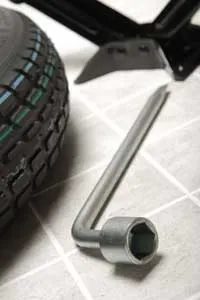
Lift the trailer until the wheel lifts clear of the ground. Check the opposite side wheel to ensure the trailer is stable and level. Loosen the lug nuts with a wrench. Do not remove them yet. Raise the trailer higher. Remove the nuts completely. Slide the old wheel off. Install the new one. Tighten the nuts by hand first. Lower the trailer. Torque the lug nuts to the manufacturer’s spec.
Underinflation kills trailer tires more than any other factor. Most failures stem from air pressure that is too low. The sidewalls flex excessively. Heat builds up. The rubber fails. Always inflate to the maximum pressure listed on the sidewall. Ignore the pressure recommended for your vehicle. Trailer tires are not passenger tires. They handle load differently. They need higher pressure to support the weight without overheating.
Heat complicates pressure readings. Sunlight bakes the tread. Driving generates friction. The air inside expands. The gauge reads higher than the actual cold pressure. If the tires are hot, add 3 psi above the maximum rating. This accounts for the air contracting as it cools down. Wait for the tires to cool before doing an accurate check. This prevents overinflation on a cold morning.
Age is a silent killer. Rubber degrades. Oxidation sets in. Tires dry rot even if they have zero miles on them. Manufacturers recommend replacing trailer tires every three to five years. Do not wait for a flat. Check the date code on the sidewall. If the tire is older than five years, replace it. Period.
“Most trailer tire failures occur due to underinflation.”
The stakes are higher with a trailer. You don’t steer it directly. You influence its path. A blowout at 65 mph can send a loaded trailer into a spin. Proper maintenance is not optional. It is the only way to keep the rig on the pavement.
Related Articles
- How Loading and Unloading Towed Vehicles Works
- How Backing Up Towed Vehicles Works
- How Boat Towing Safety Works
- How Launching a Boat Works
- How Tires Work
- How to Brake While Towing
- How to Shift While Towing
- How to Turn While Towing
- How to Pass While Towing
Sources
- Cook, Miles. “Trailer Towing Q&A.” Edmunds.com. 2008.
- “Frequently Asked Questions.” KMT Service Parts. 2008.
- “Special Trailer Tires Vs Passenger Tires.” Taskmaster Trailer Tires.
- “Trailer Tires.” Natasha’s Camping Site. 2006.
- “Trailer Tire Facts.” Discount Tire Company. 2008.