Most car buyers face a brutal trade-off. You want safety and cargo space for the kids and the weekly grocery run. You get that. But you lose the sporty handling that makes driving fun. Want better gas mileage? You usually have to settle for a smaller, less capable machine. True perfection is rare.
BMW is trying to break that cycle. Their recent lineup of SUVs and sedans claims to deliver performance, room, and even environmental responsibility. The company has been laser-focused on building high-tech gasoline and diesel engines with low emissions.
Then came the X6.
A few years ago, BMW dropped the X6 with zero warning. It was weird. It blurred the lines between an SUV, a hatchback, and a sports car. The roofline sloped down like a coupe. Yet it sat tall on big tires and could handle off-road terrain. It was an SUV with eye-catching style and potent acceleration. Under the hood sat turbocharged six- and eight-cylinder engines. Cargo space was substantial too.
BMW even built the X6 M. It featured a 555-horsepower V8. It was as fast as the previous-generation M3 sport sedan. All that fun and utility came with a tax. Fuel economy suffered. The regular V8 X6 gets about 12 miles per gallon in the city. Highway numbers hit 18 miles per gallon. The M version likely fares worse.
What if you didn’t have to pay that price? Can you really have your cake and eat it too? BMW thinks yes. They built the BMW X6 ActiveHybrid to prove it.
Hybrids pair gasoline or diesel engines with electric motors. This boosts fuel economy and cuts emissions. This tech is spreading to big, fast vehicles now. We will look at this hybrid version of BMW’s unusual performance SUV. We’ll see how advanced tech helps the BMW X6 ActiveHybrid beat standard efficiency. BMW calls this “Efficient Dynamics.”
BMW X6 ActiveHybrid Design
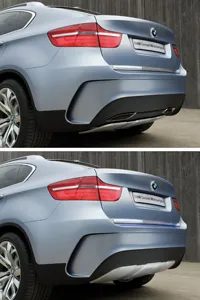
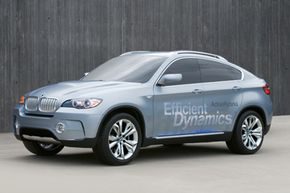
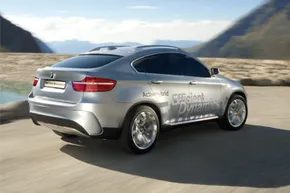
The first thing that hits you when looking at the BMW X6 ActiveHybrid is its shape. It looks nothing like a traditional SUV. The roofline curves sharply toward the rear, mimicking the sleek profiles of a Volkswagen CC or a Mercedes-Benz CLS. BMW refuses to call it an SUV. They label it a “Sports Activity Coupe.” It’s a marketing spin that ignores the four-door reality of the vehicle.
The aesthetic is aggressive. It’s not for everyone. The automotive press has split down the middle on whether the look works or falls flat. The design relies on big, 21-inch tires to ground the stance. A unique front bumper adds to the muscular appearance. But that sloping roof comes with a penalty.
You lose space. Specifically, rear headroom and cargo capacity take a hit compared to the boxier X5. The X6 is lower and longer than its conventional sibling. The X5 offers three rows of seats. The X6 settles for two. It seats four people max. It’s a trade-off for style.
High-Tech Cabin Controls
Step inside and the tech jumps out. The gear selector isn’t a lever. It looks like a joystick from a video game. You push it up for higher gears and down for lower ones. It’s an odd choice that takes getting used to.
BMW also installs their latest iDrive system. It’s a knob and screen combo that controls audio, climate, and navigation. You can tweak settings without taking your eyes off the road for long. The interface is familiar to anyone who has driven a modern BMW.
Handling and All-Wheel Drive
Safety and handling get a boost from the xDrive all-wheel-drive system. It works with Dynamic Performance Control. This setup distributes power to all four wheels based on road conditions. The result is agile handling. It’s precise.
This matters because the car weighs over 5,000 pounds (2,268 kg). Most cars that heavy feel like boats. The X6 doesn’t. The tech helps it feel lighter on its feet. You get confident grip on any surface.
Electric-Only Features
The hybrid system has some clever tricks. It was unveiled at the 2007 Frankfurt Auto Show. One feature highlights its electric capability. Aluminum plates under the car slide out. They cover the exhaust tips. This happens when the car runs solely on electric power. It hides the fact that the engine is off. It’s a small detail. It reinforces the eco-friendly image.
We’ll dig into the powertrain next. How the electric motor boosts fuel economy and performance is the real story.
BMW X6 ActiveHybrid Specs
The GM-BMW-Daimler Two-Mode Hybrid Architecture
Skip the inline-six or the standard V8. The ActiveHybrid X6 drops the conventional powertrain entirely. Instead, it pairs a V8 with two electric motors. This isn’t a mild hybrid setup. It is a serious, complex mechanism. BMW, General Motors, and Daimler developed this two-mode hybrid system together. The heart of the operation lies in the transmission. It uses three distinct gearsets. These gears split torque between the combustion engine and the electric units. Power flows from a large battery pack to those motors.
The transmission acts as the brain. It decides when to draw from the battery, the tank, or both. This architecture suits large vehicles because it handles heavy loads well. It has already proven itself on GM transit buses. The tech is battle-tested.
Efficiency and Performance Tradeoffs
“Efficient Dynamics” is BMW’s branding for this approach. The goal is simple. Drive fast. Save fuel. The system switches between two modes. Low-speed driving and hard acceleration away from a stop use the electric motors for peak efficiency. Highway cruising and sustained high-speed bursts engage the second mode. Regenerative braking captures kinetic energy during deceleration. That energy goes back into the pack.
Electric motors provide instant torque from a standstill. The gas engine handles higher speeds. Together, they create a vehicle that feels quicker while burning less. The standard V8 makes 400 horsepower. The hybrid likely pushes past that. But it achieves this with lower consumption. BMW claims a 20 percent improvement in fuel economy.
We are talking about a heavy SUV here. A 20 percent gain over the standard V8 suggests nearly 22 mpg on the highway. That is 9.4 liters per 100 kilometers. Respectable. Especially for a car built for spirited driving.
Weight, Cost, and the 2010 Timeline
There is always a price for technology. The ActiveHybrid system adds weight. It also adds cost. The concept was previewed for a potential production run by 2010. It showed that SUV capability, high performance, and reasonable emissions could coexist. They don’t usually. But here they do.
The X6 ActiveHybrid concept proved that hybrid tech could move upmarket. It wasn’t just about saving a few cents at the pump. It was about maintaining the driving feel. BMW wanted an exhilarating drive. They didn’t want to compromise. The two-mode system made that possible.
Sources from 2009 indicate strong interest in this direction. Automobile Magazine and Edmunds covered the Frankfurt auto show reveal. Eurotuner and Jalopnik focused on the driving dynamics. The technology laid the groundwork for future luxury hybrids.
Related Resources
- 5 Luxury Hybrids
- 5 Reasons to Buy a Hybrid
- Electric Car Quiz
- How Hybrid Cars Work
- How the Ford Escape Hybrid Works
- How the Venturi Fetish Works
Sources
- Automobile Magazine. ” Auto Shows: 2007 BMW X6 Active Hybrid Concept.” (Sept. 15, 2009)
- BMW.com. “Fast torque – The benefits of BMW ActiveHybrid.” (Sept. 15, 2009)
- Stahl, Andreas. “BMW X6 ActiveHybrid Concept.” Edmunds.com. (Sept. 15, 2009)
- Emmerson, Greg. “First Drive: BMW X6.” Eurotuner Magazine. (Sept. 15, 2009)
- Wert, Ray. “BMW X6 M: First Drive.” Jalopnik.com. (Sept. 15, 2009)